Is There a Best Time of Day for Stair Workouts? Here's What Actually Changes
Quick Answer: Evening stair workouts typically allow for higher output — body temperature and muscle flexibility peak in the late afternoon — while morning sessions boost consistency since fewer things derail an early routine. Pick evening for performance goals, morning for adherence goals.
You’ve probably noticed stair climbing feels harder first thing in the morning than it does after work — that’s not just being less awake, it’s measurable physiology working against you at 7am and for you at 5pm.

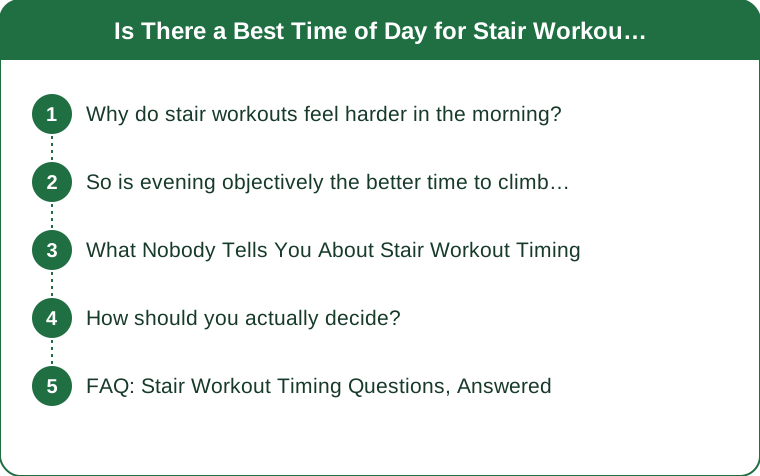
Why do stair workouts feel harder in the morning?
Core body temperature and muscle flexibility are naturally lower in the early morning, typically bottoming out around 4-6am and rising steadily through the day, peaking in late afternoon/early evening. Lower temperature means less pliable muscle tissue and slightly reduced power output.
This is measurable, not just perception — studies on time-of-day performance consistently show peak strength and power output occurring in the 4-8pm window for most people, following the body’s natural temperature rhythm.
So is evening objectively the better time to climb stairs?
For pure performance, evening has a real edge — you’ll likely climb faster, longer, or with less perceived effort at the same fitness level. But performance isn’t the only variable that matters.
Morning workouts consistently show higher long-term adherence in research, because fewer things (work emergencies, social plans, fatigue) interfere with an early slot before the day has a chance to derail it.

What Nobody Tells You About Stair Workout Timing
The performance gap between morning and evening shrinks the more consistently you train at that time. Your body adapts its circadian rhythm partially to match your habitual training window — regular early-morning climbers narrow the morning performance gap within 2-3 weeks of consistent training.
So the ‘best’ time isn’t fixed — it’s whichever time you can actually repeat consistently, since consistency itself partially closes the physiological gap over time.
How should you actually decide?
Choose evening if: you’re training for a specific performance goal (event, PR, max effort) and can reliably protect that time slot.
Choose morning if: your biggest challenge has historically been sticking with a routine, or your schedule reliably falls apart by evening.
Either way, a proper 5-minute warmup (dynamic leg swings, easy stair climbs at 50% effort) closes most of the morning performance gap regardless of which time you pick.
FAQ: Stair Workout Timing Questions, Answered
Does time of day affect calorie burn from stair climbing?
Marginally — evening sessions may burn slightly more due to higher output, but the difference is small compared to the impact of workout duration and intensity.
Is it bad to climb stairs right after waking up?
Not bad, but expect it to feel harder and warrant a longer warmup than an afternoon session at the same intensity.
Can I switch between morning and evening stair workouts?
Yes — your body doesn’t require a fixed schedule, though sticking with one time long-term produces the fastest adaptation and best perceived-effort improvement.
TL;DR:
- Evening sessions (4-8pm) typically allow higher output due to peak body temperature and muscle flexibility
- Morning sessions show better long-term consistency since fewer things interfere with an early slot
- The performance gap shrinks the more consistently you train at a given time
- A proper 5-minute warmup closes most of the morning disadvantage regardless of time chosen
Pick evening for performance, morning for consistency — and warm up properly either way to close most of the gap.
Keep Reading
This article is for general informational and styling purposes only. Fit, sizing, and product availability may vary.