Why Holding the Handrail Changes Your Stair Workout More Than the Pace
Quick Answer: Even light handrail contact offloads a meaningful share of your body weight and removes almost all of the balance demand — which is a large part of what stair climbing trains. Estimates from stair and treadmill research suggest handrail support can reduce energy cost by 20 to 25% even when the grip feels incidental. Let go, slow down, and you get more from the same flight.
You’ve been doing the stairwell twice a week and the numbers aren’t moving the way they did in the first month. The pace is the same, the flights are the same, and somewhere along the way your hand started resting on the rail without you deciding it should.
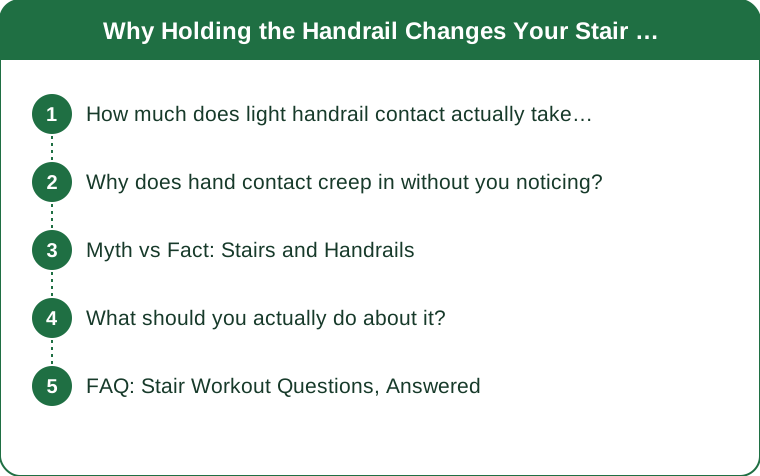
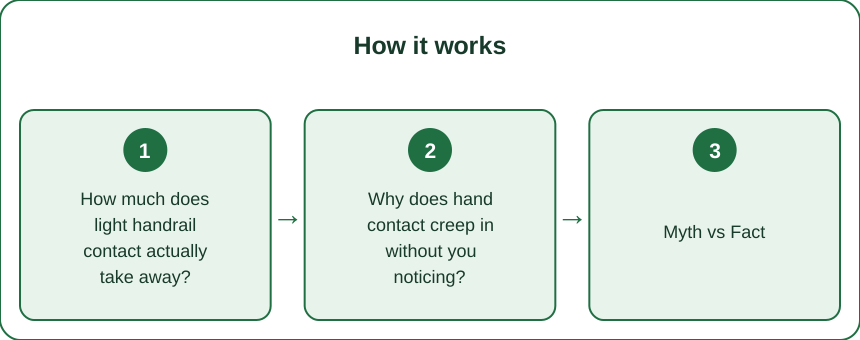
How much does light handrail contact actually take away?
More than it feels like, through two separate mechanisms.
Weight offloading. Even a hand that feels like it’s just brushing the rail transmits force. Research on treadmill and stair ergometry consistently finds that handrail use reduces measured energy expenditure substantially — commonly in the range of 20 to 25% for light support, and considerably more for a firm grip. Your heart rate drops, your perceived effort drops, and the work you’re doing drops with it.
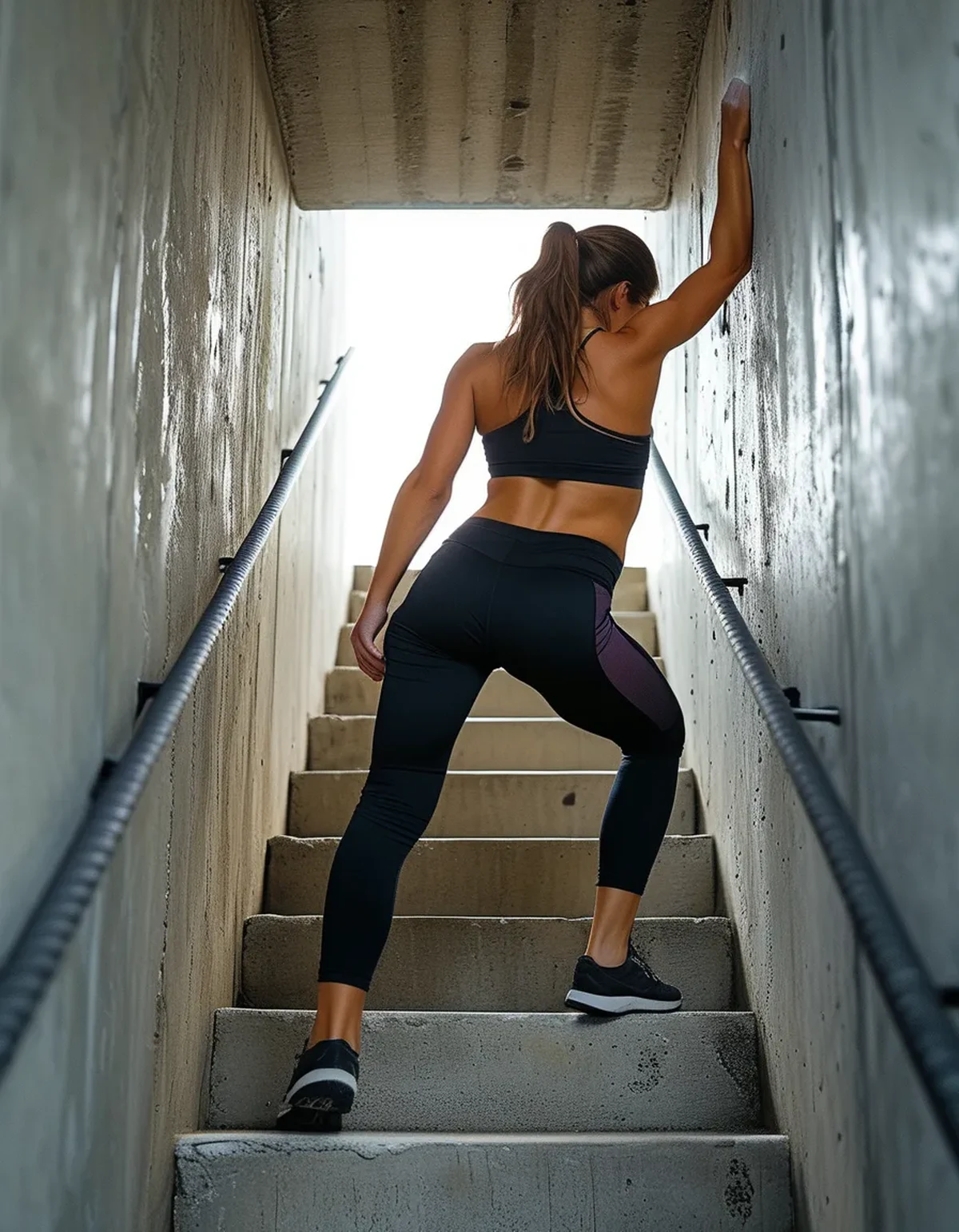
Balance demand removal. This is the part people underestimate. A significant portion of what stair climbing trains is single-leg stability — your hip, ankle and trunk controlling a body mass that’s momentarily balanced on one foot at an elevated position. A hand on the rail removes almost all of that demand instantly, because you now have a third point of contact and a source of external correction.
That second mechanism is why the handrail matters more than the pace. Slowing down reduces the cardiovascular demand but leaves the stability work intact. Holding the rail leaves some of the cardiovascular demand but removes the stability work almost entirely — and stability is the thing that transfers to everything else you do.
Why does hand contact creep in without you noticing?
Because it’s a fatigue response, and fatigue responses don’t announce themselves.
The sequence is consistent: you climb without the rail for the first several flights, your stabilizing muscles fatigue, your balance gets marginally less certain, and your hand goes out. Not as a decision — as a reflex. By the time you notice, you’ve been holding for three flights.
This is worth knowing because it identifies the actual training frontier. The flight where your hand reaches for the rail is the flight where the stability work is happening. That’s the useful part of the session, and it’s the part that gets removed exactly when it becomes valuable.
There’s a second, less obvious pathway: descending. Coming down stairs is where most people hold the rail deliberately, and descending is a heavy eccentric load on the quads and a genuinely different balance demand. If your session includes descending flights, holding the rail on the way down removes a substantial portion of the total work.
And a third: phone in one hand. Holding a phone changes arm swing, which changes balance, which increases the likelihood of reaching for the rail. It’s a small thing that reliably degrades a session.
Myth vs Fact: Stairs and Handrails
Myth: A light touch is basically the same as not touching.
Fact: It isn’t — the measured difference between light contact and none is large. The perceptual difference is small, which is exactly why the habit forms.
Myth: Using the rail lets you go faster, so it evens out.
Fact: It lets you go faster at a lower total workload. You cover more flights doing less work per flight, and the balance component is gone regardless of pace. If you want more cardiovascular demand, add flights without the rail rather than pace with it.
Myth: The rail is only about safety.
Fact: It’s about safety and it’s a significant training variable. Both are true, which is why the answer isn’t ‘never touch it’ — it’s ‘know what it costs and choose deliberately.’
Myth: Handrail use matters less on a StairMaster than on real stairs.
Fact: It matters more, if anything. Machine displays calculate work from step rate and resistance and have no idea you’re supporting yourself. The calorie figure on a StairMaster with your hands on the rails is substantially overstated — this is one of the largest sources of error in gym cardio displays.
Myth: If you need the rail, you should stop the session.
Fact: Needing it means you’ve found the edge of your current capacity, which is useful information. Rest at the landing instead — thirty seconds standing still restores more than a flight with the rail gives you.
What should you actually do about it?
Change the structure so the rail is available for safety and not used for support.
Hands off, arms swinging, as the default. Natural arm swing contributes to balance and rhythm. Arms folded or hands in pockets removes a balance aid and makes the hand-reach more likely.
Use rest, not the rail. When stability starts going, stop at a landing for 20 to 30 seconds. A short standing rest preserves the quality of the next flight; a rail-assisted flight just adds a low-value flight.
Count your rail touches. Not to eliminate them — as a metric. If you touched the rail nine times last week and five this week over the same flights, that’s genuine progress that no other number in your session captures.
Descend without it too, but slowly and only where the steps are even and well lit. Descending is where a fall actually costs something, so this is the one place to be conservative.
Do keep a hand near it in specific conditions: wet steps, poor lighting, uneven treads, carrying anything, or at the end of a session when you’re genuinely fatigued. The point isn’t never to use it. It’s to notice that using it is a choice with a cost, and to stop making the choice by default.
FAQ: Stair Workout Questions, Answered
Is it safe to climb without the handrail?
On even, well-lit stairs with clear treads, for most people, yes — and it’s how you use stairs the rest of the day anyway. Anyone with balance concerns, dizziness, or a history of falls should keep a hand available and speak to a professional about what’s appropriate. This is general information, not medical advice.
Does this apply to StairMasters too?
More so. The offloading is easier on a machine because the rails are positioned for it, and the display doesn’t account for it at all. If your machine numbers look great and your progress doesn’t, this is the first thing to check.
Should I add weight instead of removing the rail?
Remove the rail first. Adding a weighted vest while still supporting on the rail is adding load to a movement you’re partially offloading — you’ll get more from the same session by fixing the contact first, and it costs nothing.
Why do my legs shake at the top of a rail-free session?
That’s the stabilizers doing work they weren’t doing before. It settles within a few sessions and it’s the clearest sign that removing the rail changed what the workout is training.
TL;DR:
- Light handrail contact can cut energy cost by 20-25% and removes nearly all the balance demand.
- Hand contact creeps in as a fatigue reflex — right at the point the session becomes useful.
- Rest at a landing for 30 seconds instead of taking a rail-assisted flight.
- StairMaster calorie readouts don’t account for rail support at all.
- Keep the rail for wet steps, poor light, uneven treads and genuine fatigue — as a choice, not a default.
The pace was never the variable holding your stair sessions back. Counting rail touches for two weeks tells you more about your progress than any other number in the session.
Keep Reading
This article is for general informational and styling purposes only. Fit, sizing, and product availability may vary.