Why Stair Workouts Get Harder When You Move Them Indoors for the Season
Quick Answer: Indoor stairwells have shorter, steeper flights with frequent turns, no airflow, and typically higher air temperature, which raises heart rate at the same work rate. The turns break rhythm and add eccentric load on the descent. Expect roughly the same session to feel 10 to 20 percent harder for the first two weeks.
It catches people out every autumn. The stadium steps or park stairs that produced a repeatable, satisfying session in August become an office stairwell in October, and suddenly the same number of flights leaves you significantly more cooked.

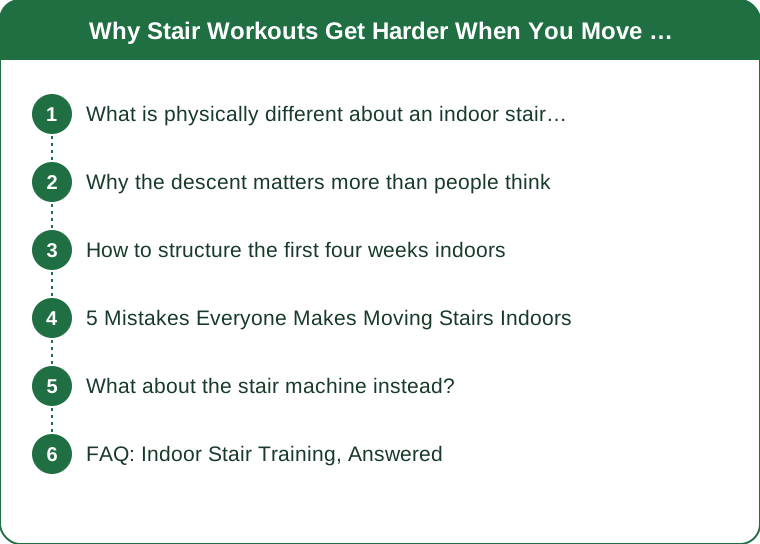
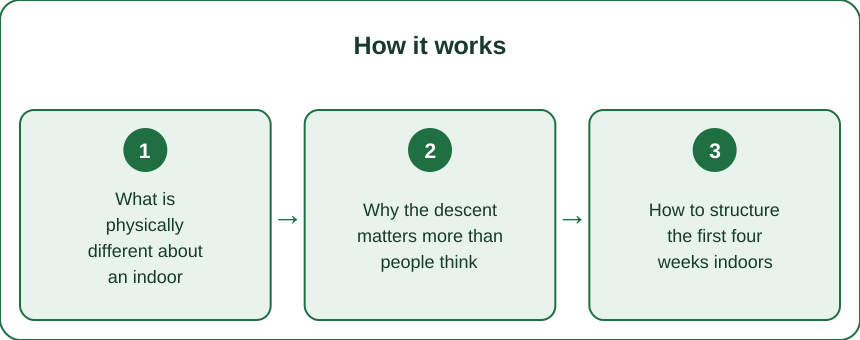
What is physically different about an indoor stairwell?
Four things, and they stack rather than average out.
Flight geometry. Outdoor stadium and park steps tend to have deeper treads and lower risers, designed for crowds walking. Indoor building stairs are built to code minimums for space efficiency, meaning higher risers and shallower treads. A higher riser means more hip and knee flexion per step and more work per step.
Turns. A stadium flight might run 40 steps straight. A building stairwell runs 8 to 12 steps then a landing then a 180-degree turn. Every turn costs momentum and adds a lateral loading demand that straight climbing doesn’t have.
Air. A stairwell is an enclosed vertical shaft, often warm, with essentially no airflow. Outdoors you had convective cooling. This alone raises heart rate meaningfully at the same output.
Descent. Outdoors, many people jog down a ramp or path. Indoors, the only way down is the same stairs, which means significantly more eccentric loading on the quads and considerably more next-day soreness.
Why the descent matters more than people think
Because descending stairs is eccentric work, and eccentric work is where most of the muscle damage and delayed soreness comes from.
When you step down, your quadriceps lengthen under load to control the descent. That contraction type produces more microscopic muscle damage per unit of effort than concentric work, which is why walking downhill leaves you sorer than walking uphill despite feeling easier at the time.
In an outdoor session where you jog down a ramp, you’re skipping most of that. In a stairwell where you descend every flight you climbed, you’re doubling the session’s total loading in a way the effort meter doesn’t register.
The practical consequences: two-day soreness is normal in the first weeks and doesn’t indicate a problem, and if there’s a lift available, taking it down for the first few sessions is a legitimate way to manage the transition rather than a cop-out.
It’s also why knee complaints tend to appear in the descent rather than the climb, and why controlled, quiet descending, landing softly with a bent knee rather than thumping down, is worth practising deliberately.
How to structure the first four weeks indoors
Week 1: cut volume by a third and take the lift down. The goal is establishing the movement pattern and the heat tolerance, not matching August numbers.
Week 2: restore volume, still descending by lift or with half the descents walked.
Week 3: introduce full descents on half the repeats.
Week 4: normal session.
Within a session, the useful structure indoors is different too. Long continuous climbs suit outdoor stairs; indoors, the turns break rhythm anyway, so interval structures work better. Three to five minutes of climbing, two minutes of easy walking on a landing or flat corridor, repeated four to six times, is a well-suited format.
And take the heat seriously. A stairwell in a heated building can run several degrees above the rest of the floor, and there’s no wind. Bring water, and if the building has a window or a door to a cooler landing, use it during recoveries.

5 Mistakes Everyone Makes Moving Stairs Indoors
1. Matching outdoor volume in week one. The riser height alone makes each step more work. Same flights is not the same session.
2. Taking two steps at a time by default. It’s a legitimate variation that shifts emphasis toward glutes and demands more hip range, and on a steep indoor riser it’s a big ask. Save it for when you’ve adapted.
3. Gripping the handrail to pull yourself up. It offloads the legs and quietly reduces the training effect. Use it for safety and balance, not propulsion.
4. Sprinting the descent. The descent is where the injury risk and the soreness live. Controlled and quiet, always.
5. Ignoring the surface. Indoor stair nosings vary and some are slick, particularly in older buildings or when wet from shoes. Trainers with genuine grip matter more indoors than on textured concrete outdoor steps.
What about the stair machine instead?
It’s a reasonable substitute and it’s a genuinely different stimulus, worth understanding before you swap.
The stair machine has consistent step height, no turns, and no descent. That makes it more measurable and much easier on the knees, since eccentric load is essentially removed. It’s the better choice for anyone managing knee discomfort.
What it loses is the descent training, the turn agility, and the real-world specificity. It’s also a fixed cadence machine, so it’s harder to do genuine intervals unless you change the setting mid-session.
A practical combination for autumn: one stairwell session and one machine session per week, which gives you the eccentric adaptation without doubling the soreness.
And a note on either: if you get sharp knee pain rather than muscular burning, particularly on descent or on the machine’s steepest settings, that’s a stop-and-assess signal rather than something to train through. This is general information, not medical advice.
FAQ: Indoor Stair Training, Answered
How many flights is a good session?
It depends entirely on flight length, but a useful starting benchmark is total vertical metres. Around 100 to 150 vertical metres is a solid session; a typical building flight is roughly 3 metres.
Is it safe to train in a building’s fire stairs?
Check with the building first. They’re often permitted and sometimes not, and stairwell doors that lock behind you are a genuine and common hazard worth verifying before your first session.
Why do I get more out of breath indoors at the same pace?
Higher air temperature, no airflow, and often stale air in an enclosed shaft. Heart rate rises at the same work rate, which raises perceived effort.
TL;DR:
- Indoor stairs have higher risers, frequent turns, no airflow, and a full eccentric descent you didn’t do outdoors.
- Expect the same session to feel 10 to 20 percent harder for two weeks, and cut volume by a third in week one.
- The descent causes most of the soreness and most of the risk, so control it and consider the lift early on.
- Intervals suit indoor stairwells better than long continuous climbs, because the turns break rhythm anyway.
Same exercise, different task. Four weeks of deliberate transition beats two weeks of matching August and then stopping. This is general information, not medical advice.
Keep Reading
This article is for general informational and styling purposes only. Fit, sizing, and product availability may vary.