How to Add Stairs to a Running Plan Without Wrecking Your Easy Days
Quick Answer: Stair sessions are a hard day, not a cross-training day — the descent produces significant eccentric loading and delayed soreness that will contaminate your easy runs for two to three days. Put stairs the day after your existing hard session or two days before it, start with 8 to 12 minutes of climbing, and walk the descents for the first month.
You added stairs on Tuesday because it seemed like a good extra.
By Thursday your easy run was not easy and Saturday’s long run felt awful.
The stairs were not the mistake. The placement was.

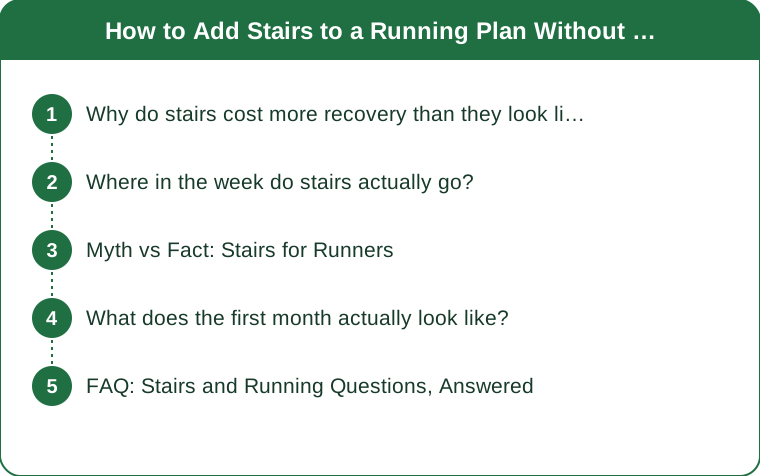
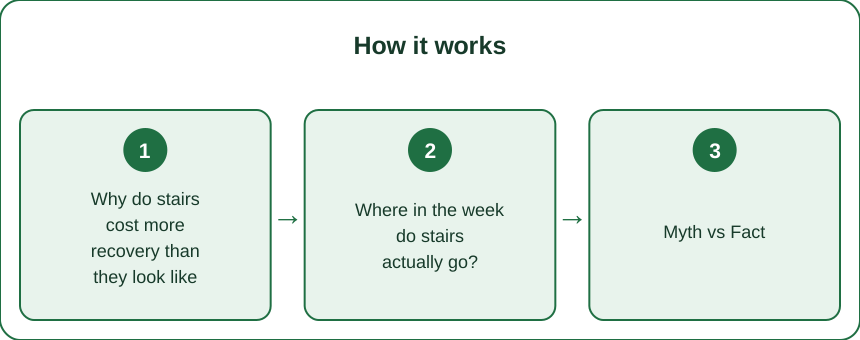
Why do stairs cost more recovery than they look like they should?
Because of the descent, not the climb.
Going up is concentric work — muscles shortening under load. It is metabolically demanding, your heart rate climbs fast, and it produces very little muscle damage.
Going down is eccentric — muscles lengthening under load while braking your body weight. Eccentric contractions produce far more muscle damage than concentric ones at the same effort, and muscle damage is what causes delayed onset soreness.
That soreness peaks 24 to 48 hours later. Which is why the day after a stair session usually feels fine and the day after that does not — and why runners mis-attribute the bad Thursday to something they did on Wednesday.
Quads take the majority of it. Descending stairs loads the quadriceps eccentrically in a very concentrated way, and sore quads change your running gait, which spreads the cost to everything else.
The upside is that this is exactly why it works. Eccentric loading is what builds durability for downhill running and late-race resilience, and it is the specific quality that flat road running does not develop. The cost and the benefit are the same mechanism, which means the answer is placement rather than avoidance.
Where in the week do stairs actually go?
Three placements that work, and one that does not.
Best: the day after your existing hard session. Stacking hard days together and then taking genuine easy days is more effective than spreading hard efforts evenly, because it protects the easy days from being half-hard. If you do intervals on Tuesday, stairs go on Wednesday.
Second best: two days before your hard session, with an easy day between. This works if you keep the stair session short.
Also fine: as a replacement for a hill session rather than as an addition. Stairs and hill repeats train overlapping qualities, so running both in the same week is usually redundant and always expensive.
What does not work: the day before a long run or a quality session. Sore quads compromise both, and you will run the important session at a lower quality than if you had skipped the stairs entirely.
And the rule people break most: stairs are not a cross-training day. They are not the running equivalent of a swim or a bike session — those are genuinely low-damage. A stair session belongs in your hard-day budget, and most runners only have two or three of those a week.

Myth vs Fact: Stairs for Runners
Myth: stairs are just a harder version of running. Fact: the mechanics are substantially different. The stride is shorter, the hip and knee flexion are greater, and the calf and quad contributions are much larger than in flat running. That is why it builds something running does not — and why it does not fully substitute for running.
Myth: running down is good training too. Fact: running down stairs is where the injuries are. The combination of high eccentric load, high foot speed, and a trip hazard is the worst risk profile in the whole activity. Walk the descents for at least the first month, and take the lift or a ramp if one exists.
Myth: more flights is better. Fact: the stimulus saturates faster than the damage does. Doubling the volume roughly doubles the soreness and adds far less fitness, which is a poor trade in a running week where the easy days matter.
Myth: stair machines are the same thing. Fact: a stair machine removes the descent entirely, which removes both most of the damage and most of the specific benefit. A stair machine is a genuine cross-training option; real stairs are a hard session.
Myth: stairs will improve your flat running pace. Fact: they improve hills, durability, and single-leg strength, and transfer to flat pace only indirectly. If flat speed is the goal, the session that develops it is running fast on the flat.
What does the first month actually look like?
A conservative progression, because the soreness from a first stair session is genuinely notable.
Week 1: 8 minutes of climbing, walking every descent. Two to four flights per rep, easy jog or walk recovery. This will feel too easy on the day and will not feel too easy on Thursday.
Week 2: 10 to 12 minutes, still walking down.
Week 3: 12 to 15 minutes, one or two descents jogged if the surface is safe and even.
Week 4: 15 to 20 minutes, and this is a reasonable ceiling for a runner using stairs as a supplement rather than a specialty.
Warm up properly first — ten minutes of easy running minimum. Cold quads and a hard eccentric session is the combination that produces strains rather than soreness.
Keep the effort at hard-but-repeatable rather than maximal. You should be able to complete the last rep at the same pace as the first, and if you cannot, the session was too long.
A seasonal note that matters right now: outdoor stairs get riskier as leaves fall and mornings turn damp. Wet leaves on stone steps are as slippery as ice, and the descent is where you meet them. Through autumn, favour covered stairwells, shift to daylight hours, and be more conservative about jogging down than you were in summer.
FAQ: Stairs and Running Questions, Answered
Can stairs replace hill repeats?
Largely, yes — they train overlapping qualities and stairs are more accessible for most people. Hills are more specific if you race on hills, because the gradient is continuous and the stride is closer to running. Stairs are a good substitute when there are no hills.
How long does the soreness last the first time?
Typically two to four days, peaking at 24 to 48 hours. It reduces dramatically after the second or third session — this is the repeated bout effect, and it is why the first session is the one to underdo.
Should I take the stairs two at a time?
Sometimes, deliberately. Two at a time increases hip and glute involvement and reduces cadence, which is a different stimulus rather than a harder one. It also increases trip risk, so save it for stairs you know well.
Is a stair machine a reasonable substitute?
As cross-training, yes, and it is much easier on recovery because there is no descent. As a replacement for the eccentric benefit, no — the descent is the part that builds downhill durability.
My knees hurt going down. Should I stop?
Stop descending under load and use a lift, ramp, or a different route. Knee pain on descent is common and is not something to train through — it is a signal about load tolerance and often about strength. Persistent knee pain is worth a physiotherapist rather than a plan adjustment; this is general information, not medical advice.
TL;DR:
- The descent is the expensive part: eccentric loading causes damage that peaks 24 to 48 hours later.
- Stairs are a hard day, not a cross-training day — budget them against your two or three hard sessions.
- Best placement is the day after your existing hard session, protecting genuine easy days.
- Never the day before a long run or quality session; sore quads compromise both.
- Start at 8 to 12 minutes of climbing and walk every descent for the first month.
- Wet leaves on outdoor steps in autumn make the descent the riskiest part of the session.
Stairs build what flat running cannot — as long as they land on a day that can afford them.
Keep Reading
This article is for general informational and styling purposes only. Fit, sizing, and product availability may vary.