Does Holding the Handrail While Stair Climbing Actually Reduce the Workout Benefit?
Quick Answer: Yes, holding the handrail measurably reduces workout intensity by offloading some body weight through your arms onto the rail, which reduces how hard your legs and cardiovascular system have to work — research on stair machines specifically shows meaningful calorie burn reductions (sometimes 20% or more) when using the handrail for support rather than balance alone.

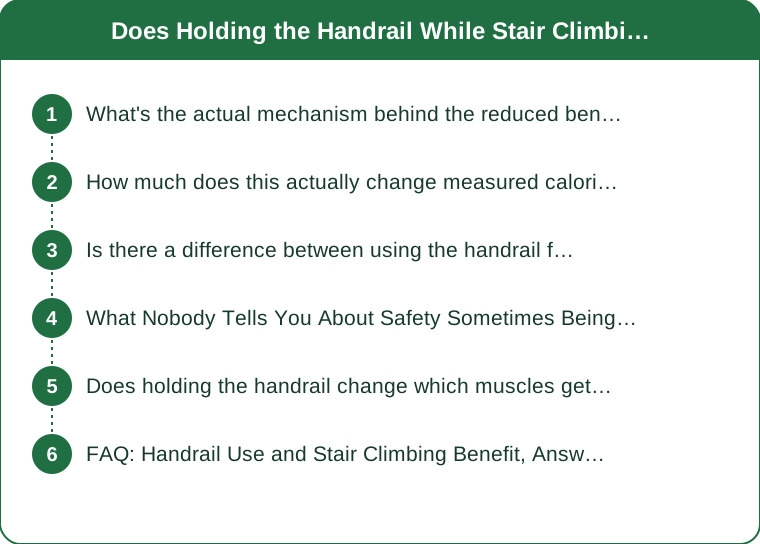
What’s the actual mechanism behind the reduced benefit?
When you grip and lean on a handrail, some portion of your body weight transfers through your arms to the rail instead of being carried entirely by your legs, which directly reduces the muscular work your legs perform per step and lowers the cardiovascular demand of the exercise — this is a straightforward physics effect, not a minor psychological one.
How much does this actually change measured calorie burn?
Studies specifically on stair-climbing machines have found handrail use can reduce measured calorie burn by roughly 20 percent or more compared to climbing without support, which is a substantial enough difference that machine calorie displays are sometimes considered inflated or inaccurate specifically because they don’t account for handrail-assisted effort reduction.
Is there a difference between using the handrail for balance versus for support?
Yes — lightly touching the rail for balance without meaningfully transferring body weight through your arms preserves most of the workout benefit, while actively gripping and leaning to reduce leg workload is what causes the meaningful calorie burn reduction — the distinction is in how much weight is actually being offloaded, not whether your hand touches the rail at all.

What Nobody Tells You About Safety Sometimes Being More Important Than Maximizing Burn
For anyone with balance concerns, joint instability, or who is new to stair climbing, using the handrail for genuine safety and stability is a reasonable tradeoff against a somewhat lower calorie burn — the workout benefit reduction is real, but it doesn’t mean handrail use is never appropriate; safety-driven handrail use is a legitimate choice, not a failure to properly execute the workout.
Does holding the handrail change which muscles get worked, not just how much?
Yes — offloading weight through the arms reduces the relative work done by the glutes, quads, and calves specifically, meaning beyond the calorie burn reduction, the targeted lower-body strengthening benefit of stair climbing is also somewhat diminished when significant weight is transferred to the arms during the climb.
FAQ: Handrail Use and Stair Climbing Benefit, Answered
Is it better to not use the handrail at all, even for balance touches?
Light balance touches without weight transfer are generally fine and don’t meaningfully reduce benefit, so avoiding the handrail entirely isn’t necessary for people who don’t have specific balance or safety concerns.
Do stair-climbing machine calorie displays account for handrail use?
Most displays don’t distinguish between handrail-assisted and unassisted climbing, meaning displayed calorie estimates can overstate actual burn for people using significant handrail support.
Does increasing speed or resistance offset the reduced benefit from handrail use?
Partially — increasing pace or resistance while still using the handrail can help recover some of the lost intensity, though it doesn’t fully replace the leg-specific and cardiovascular benefit of climbing without support.
TL;DR:
- Gripping and leaning on the handrail transfers body weight away from the legs, reducing workout demand
- Research on stair machines shows handrail support can reduce calorie burn by 20 percent or more
- Light balance touches without real weight transfer preserve most of the workout benefit
- Safety-driven handrail use remains a reasonable tradeoff for people with balance or joint concerns
The handrail isn’t cheating in a moral sense — it’s a real, measurable intensity reduction worth knowing about when tracking progress.
Keep Reading
This article is for general informational and styling purposes only. Fit, sizing, and product availability may vary.