Does Taking Stairs Two at a Time Actually Build More Muscle, or Just More Risk?
Quick Answer: Taking stairs two at a time does increase glute and hamstring engagement compared to single steps, due to the greater hip and knee range of motion required, but it also meaningfully increases joint load and fall risk, especially on descent — the tradeoff is real in both directions, not a clear win either way.
It feels like a small efficiency hack on the way up. Biomechanically, it’s actually a noticeably different exercise than climbing one step at a time.

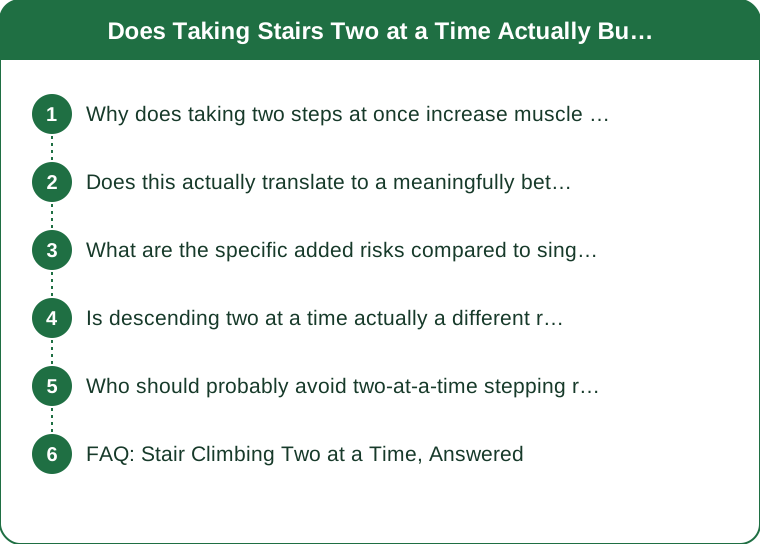
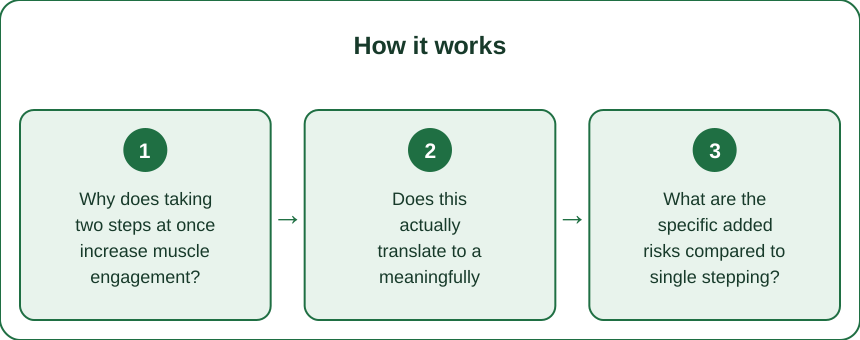
Why does taking two steps at once increase muscle engagement?
Skipping a step requires a significantly larger range of motion at both the hip and knee joints to clear the extra height, which recruits the glutes and hamstrings more heavily than the shorter range of motion used in single-stepping. The increased hip flexion and extension demand functions similarly to a deeper squat or lunge pattern, compared to the shallower movement of climbing one step at a time.
Does this actually translate to a meaningfully better workout, or is the difference minor?
For people already comfortable and stable doing it, the difference is meaningful enough to be used intentionally as a training variation — some stair-climbing workout plans alternate single and double steps specifically to vary the muscle engagement and intensity within the same session, treating double-stepping as a deliberate harder variation rather than just a faster way to get upstairs.
What are the specific added risks compared to single stepping?
The main added risks are reduced margin for error on foot placement (a bigger step means less room to correct a slightly misjudged landing) and increased strain on knee and ankle stabilizers, especially for anyone without existing lower-body strength or balance training. These risks are notably higher on the way down than going up, since a missed step while descending carries a much higher fall risk than while ascending.

Is descending two at a time actually a different risk category than ascending two at a time?
Yes, considerably — ascending with a missed or short step generally just results in catching the edge of a step and recovering, while descending with a misjudged double step has a much higher chance of an actual fall due to gravity working against recovery rather than for it, which is why many fitness and safety guidance sources specifically recommend single-stepping on the way down even for people comfortable double-stepping up.
Who should probably avoid two-at-a-time stepping regardless of fitness level?
Anyone with existing knee or hip joint issues, balance concerns, inadequate lower-body strength for the increased range of motion, or anyone on unfamiliar or poorly lit stairs should default to single stepping, since the added muscle engagement benefit doesn’t outweigh the meaningfully higher injury risk in those specific situations.
FAQ: Stair Climbing Two at a Time, Answered
Does two-at-a-time stepping burn meaningfully more calories than single stepping?
Somewhat, due to the greater range of motion and muscle recruitment per step, though the difference over a short flight of stairs is generally modest rather than dramatic.
Is it worth practicing two-at-a-time stepping specifically as a training drill?
For people with adequate lower-body strength and balance, using it deliberately on ascent as an occasional variation is reasonable, though it shouldn’t replace a full structured lower-body training program on its own.
Does footwear affect the safety of taking stairs two at a time?
Yes — secure, non-slip footwear with good ankle support meaningfully reduces the added risk, while loose sandals or worn-down soles increase it considerably given the larger step and landing force involved.
TL;DR:
- Two-at-a-time stepping increases glute and hamstring engagement through greater range of motion
- The added muscle engagement is real enough to use intentionally as a training variation
- Foot placement margin for error shrinks, increasing strain on knee and ankle stabilizers
- Descending two at a time carries meaningfully higher fall risk than ascending does
- People with joint issues or balance concerns should default to single stepping regardless
It’s a genuine muscle-engagement tradeoff, not a free upgrade — worth it selectively, not universally.
Keep Reading
This article is for general informational and styling purposes only. Fit, sizing, and product availability may vary.