Should You Do Stairs Before or After Leg Day?
Quick Answer: If strength is the priority, lift first and do stairs after — fatiguing your legs before heavy squats reduces the load you can handle and the quality of every set. If conditioning is the priority, do stairs first. If both matter equally, put them on different days, because doing hard versions of both in one session means doing a mediocre version of each.
Both are leg work, both are hard, and the order you happen to do them in is usually decided by which one you feel like starting with. It should not be.

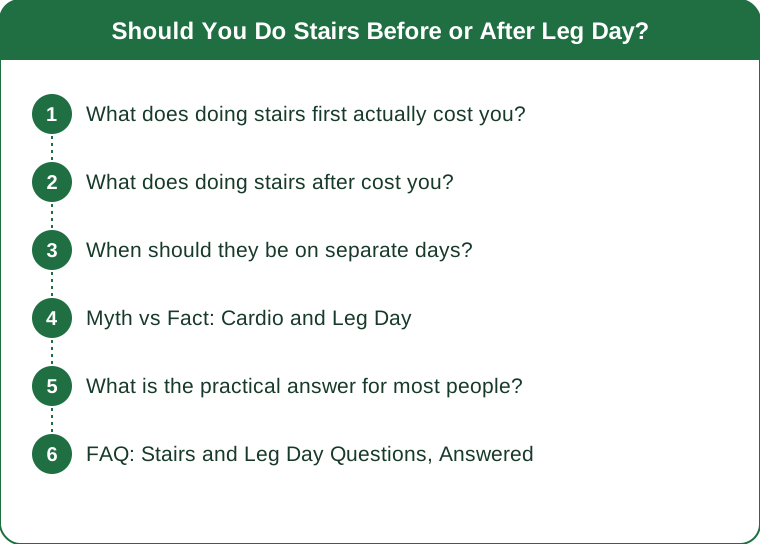
What does doing stairs first actually cost you?
Load, quality, and probably some safety margin.
Pre-fatiguing your legs reduces the weight you can lift, and it does so substantially. The quadriceps and glutes that just did fifteen minutes of climbing are not producing the same force ten minutes later. Expect to lose a meaningful percentage off your working weight — enough that the session is no longer training the same quality.
That matters because strength adaptation is driven largely by load and by high-quality repetitions. A squat set at 80% of your usual weight, done tired, does not produce the same adaptation as the same set fresh. You did the work; you did not get the stimulus.
Technique degrades too. Fatigued legs mean less control at the bottom of a squat, more knee drift, and a greater tendency for the hips to shoot up. This is where form breaks and where injuries happen, and it is worse under a loaded bar than it is on a staircase.
There is one exception worth naming: if your goal is genuinely muscular endurance or general conditioning rather than strength, doing stairs first is not a mistake. Pre-exhaustion is a legitimate technique for training the muscle rather than the movement. Just know that is what you are choosing.
The general rule holds: whatever comes first gets your best effort. Put the thing you actually care about there.
What does doing stairs after cost you?
Less than you would think, and it is not free.
The main cost is that the stair session will be worse. Your legs are tired, your pace will be slower, and your heart rate will be higher at any given effort. If you are trying to hit a specific climbing pace or a distance target, you will not.
The second cost is descent quality, and this is the one that matters for safety. Going down stairs is eccentric loading, which is the most demanding kind on both muscle and connective tissue and the primary source of stair-related knee pain. Tired legs control the descent worse, and poor descent control on a staircase is how people turn an ankle or land hard on a knee.
A third cost is total volume. Adding fifteen minutes of hard stairs to an already hard leg session is a lot of leg work in one day, and it lengthens recovery. If you train legs twice a week, stacking conditioning onto both sessions may mean you are not recovered for either.
The mitigations are straightforward:
- Keep the post-lift stair session short. Ten to fifteen minutes, not thirty.
- Walk down, do not run down. Or take an elevator if one exists — genuinely, this is not cheating.
- Reduce the intensity, not just the duration. Steady climbing rather than intervals.
Done that way, stairs after lifting is a reasonable finisher and costs very little.
When should they be on separate days?
Whenever both are actually goals, which is more often than people admit.
The honest test: if you would be disappointed by a bad stair session and a bad lifting session, they should not be in the same workout. Combining them means accepting that one of them is a warm-up or a cool-down for the other.
A sensible weekly structure:
- Heavy lower body strength: two days a week, fresh
- Stair conditioning: one or two days, on non-lifting days or on upper body days
- At least one full day between a hard stair session and a heavy squat day, because stairs produce real soreness in the quads and glutes
Stairs on an upper body day works particularly well. Your legs are fresh, the conditioning does not interfere with your pressing or pulling, and you get the cardiovascular work without adding it to an already long leg session.
The one combination to avoid: hard stairs the day before heavy squats. Descending stairs produces significant delayed-onset soreness in the quads, and it peaks 24 to 48 hours later — which is precisely when you were planning to squat. This is the sequencing error that catches people out most, and it is invisible until the squat session feels inexplicably terrible.
If you only train three days a week total, combining is often the practical answer. In that case, pick which one leads based on what you are actually training for this month, and be consistent about it rather than alternating.

Myth vs Fact: Cardio and Leg Day
Myth: Doing cardio before lifting is a good warm-up. Fact: Five to ten easy minutes is an excellent warm-up. Fifteen minutes of hard stair climbing is a workout, and it leaves your legs pre-fatigued rather than prepared. The distinction is intensity, not modality.
Myth: Cardio after lifting cancels out your strength gains. Fact: The interference effect is real and it is much smaller than gym folklore suggests, particularly at moderate volumes. A fifteen-minute stair finisher is not undoing your squats. The concern applies mainly to high volumes of endurance training alongside a strength program.
Myth: Stairs are a substitute for leg training. Fact: Stairs build cardiovascular fitness and considerable muscular endurance, and they do not provide the progressive load that builds maximal strength. They complement leg day rather than replacing it. The load is capped at your bodyweight, and that ceiling arrives fairly quickly.
Myth: If you are sore, you should not train. Fact: Mild soreness is generally fine to train through, and moderate soreness usually improves with movement. Significant soreness that limits your range of motion or changes your technique is a reason to reduce load or change the session — not because it is dangerous, but because you will train badly.
Myth: The order does not matter if the total work is the same. Fact: Order determines quality, and quality determines adaptation. The same two sessions in a different order produce genuinely different outcomes, which is the entire point of thinking about it.
What is the practical answer for most people?
Lift first, stairs after, kept short. That is the default that suits the most goals.
A workable structure for a combined session:
- Warm up properly — five to eight minutes easy, including some easy stair climbing if that is what you have, plus hip and ankle mobility
- The heavy work — squats, deadlifts, lunges, whatever the session’s main lifts are
- Accessory work if you do it
- Ten to fifteen minutes of stairs, steady rather than intervals, walking down
- Actual cooldown — a few minutes easy walking and some calf and hip flexor stretching
Total leg session: 50 to 70 minutes. If it is running longer than that, something should move to another day.
Adjust if your goal is conditioning-led: flip the order, do the stairs hard first, and treat the lifting as maintenance with lighter loads and higher reps. Be explicit with yourself that this is what you are doing rather than lifting heavy poorly and telling yourself it counted.
One seasonal note for outdoor stairs: as autumn arrives, outdoor stairs get wet, then leaf-covered, then icy, and the descent gets progressively more dangerous in exactly that order. A wet leaf on a concrete step has close to no friction. If your stair workout lives outdoors, this is the season to start checking the surface before you start and to move the harder sessions to a stairwell or a machine when conditions turn.
And if you get knee pain specifically on descent that does not settle, that is worth getting looked at rather than training around. This is general information, not medical advice.
FAQ: Stairs and Leg Day Questions, Answered
How long should I wait between a stair session and leg day?
At least 24 hours, ideally 48 if the stair session included a lot of descending. Descent-heavy work produces delayed soreness that peaks a day or two later, so a Tuesday stair session and a Thursday squat day works well, while Tuesday and Wednesday often does not.
Can I use a stair machine instead to reduce the impact?
Yes, and it changes the equation usefully. A stair machine eliminates the descent entirely, which removes most of the eccentric loading and most of the soreness. That makes it far more compatible with a heavy lifting schedule, at the cost of some of the strength and control benefit that descending actually provides.
What if stairs are my only leg training?
Perfectly reasonable as a starting point, and you will hit a ceiling within a few months because the load is capped at your bodyweight. Adding weight in a backpack extends it somewhat. Adding two or three bodyweight strength movements — squats, lunges, single-leg work — extends it much further and costs about ten minutes.
TL;DR:
- Whatever comes first gets your best effort, so put the priority there
- Strength-focused: lift first, then ten to fifteen easy minutes of stairs, walking down
- Conditioning-focused: stairs first, and treat the lifting as maintenance rather than pretending otherwise
- Never do hard descending stairs the day before heavy squats — the soreness peaks exactly then
- If both genuinely matter, put them on different days
The combined session is fine and it is a compromise. The only real mistake is running the compromise without deciding which side of it you are on.
Keep Reading
This article is for general informational and styling purposes only. Fit, sizing, and product availability may vary.