Stair Climbing Machine vs. Real Stairs: Is There Actually a Difference?
Quick Answer: Stair machines (stepmills) provide a more consistent, joint-friendly cardio load with less impact than real stairs, since your foot never fully leaves the step, while real stairs demand more balance, coordination, and slightly higher impact from actual foot lift and landing. Both are effective cardio; the difference matters most for impact-sensitive joints and functional balance training.
They look similar and target the same broad muscle groups, but a stepmill and a real staircase actually create meaningfully different demands on your body — worth knowing if you’re choosing between them for a specific goal.

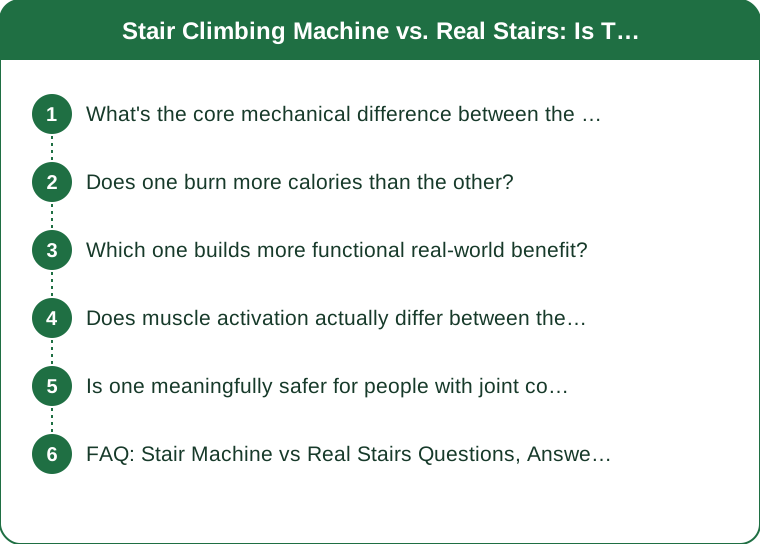
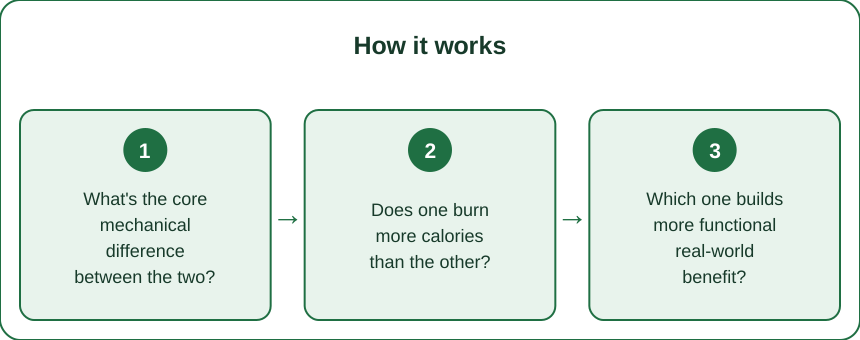
What’s the core mechanical difference between the two?
On a stepmill, the step comes to you — your foot stays in continuous contact with a moving platform, which removes the impact of a foot fully lifting and landing that happens on real stairs. Real stairs require your foot to leave the step and land again with each stride, adding a small but real impact component that a stepmill doesn’t replicate.
This makes the stepmill notably gentler on joints (knees, ankles) for the same duration and intensity of workout — a relevant factor for people managing joint sensitivity who still want stair-climbing’s cardio benefits.
Does one burn more calories than the other?
Real stairs generally demand slightly more energy for the same duration, due to the added impact and the more variable, less mechanically consistent movement pattern (real stairs aren’t perfectly uniform in height and depth the way a machine’s steps are). The difference isn’t dramatic, and intensity and duration matter far more for calorie burn than which version of stair climbing you choose.
Which one builds more functional real-world benefit?
Real stairs better train the balance, coordination, and proprioception (body position awareness) actually needed for everyday stair use — navigating an unfamiliar staircase, adjusting to uneven steps, and stabilizing sideways sway are all real-stair-specific skills a stepmill’s uniform, machine-guided motion doesn’t fully replicate.
A stepmill is better for pure, controlled cardio conditioning without those variables — useful specifically because the consistency lets you focus entirely on cardiovascular output rather than navigation and balance.

Does muscle activation actually differ between the two?
Broadly similar (glutes, quads, calves, hip flexors) but with some real differences in emphasis. Real stairs, with their impact and irregular pacing, engage stabilizer muscles around the ankle and hip more than a stepmill’s smooth, consistent motion does. A stepmill’s continuous, unchanging cadence tends to create more sustained glute and quad endurance work without the stabilizer demand.
Is one meaningfully safer for people with joint concerns?
Generally, yes — the stepmill, due to reduced impact. For people managing knee or ankle sensitivity, a stepmill offers most of stair climbing’s cardio and lower-body benefit with less joint stress than repeated real-stair impact. This isn’t a universal rule — proper stepmill form still matters, and some people find the fixed, unnatural step height of a machine less comfortable than their body’s natural stride on real stairs. This is general information, not medical advice; check with a doctor or physical therapist for specific joint concerns.
FAQ: Stair Machine vs Real Stairs Questions, Answered
Can you get the same fitness results from just one or the other?
Yes, either one alone provides solid cardio and lower-body benefit — combining both simply adds variety and covers slightly different functional and impact profiles.
Does a stepmill actually replicate real stair climbing well enough for hiking prep?
Reasonably well for general cardio and leg endurance, but real stairs or actual hill/stair training still better prepares the specific balance and uneven-terrain adaptation hiking requires.
Is one better for beginners just starting a stair-climbing habit?
A stepmill is often a gentler entry point — the consistent step height and lower impact make it easier to build a routine before progressing to real stairs, particularly for anyone starting from a lower fitness base.
TL;DR:
- Stepmills offer continuous, lower-impact motion since your foot never fully leaves the step
- Real stairs demand more balance and coordination and burn marginally more due to actual impact
- A stepmill suits joint-sensitive training and pure cardio focus; real stairs better train functional balance
- Either one delivers solid cardio and lower-body benefit — the right choice depends on your specific goal
They’re not interchangeable, but they’re also not competing options — many people get the most benefit from using both depending on the day’s goal.
Keep Reading
This article is for general informational and styling purposes only. Fit, sizing, and product availability may vary.