Does Taking Stairs Two at a Time Actually Build More Muscle, or Just More Risk?
Quick Answer: Taking stairs two at a time does increase glute and hamstring activation compared to single steps, thanks to the greater hip and knee flexion required — but it also raises trip and fall risk, especially on unfamiliar or crowded stairwells, making the tradeoff situational rather than a clear win.
Skipping steps feels more athletic, and there’s a real reason for that — but whether it’s actually the better choice depends more on the stairwell than the workout benefit.

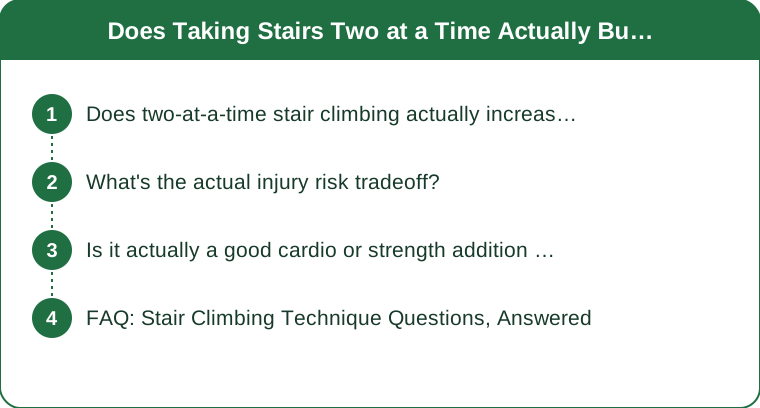
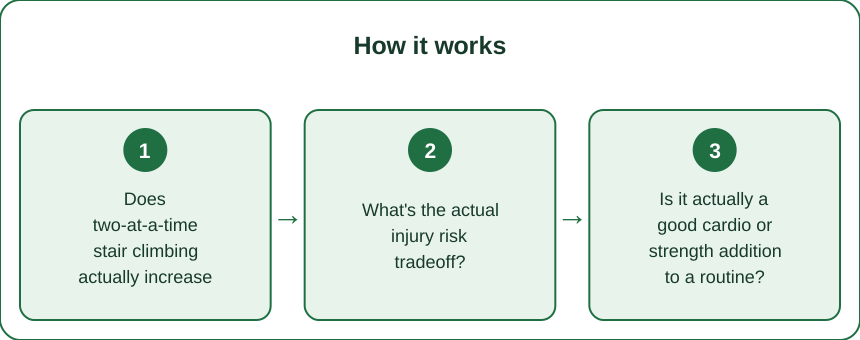
Does two-at-a-time stair climbing actually increase muscle activation?
Yes, measurably — the greater hip and knee flexion required to clear two steps per stride demands more from the glutes and hamstrings than a standard single-step climb, similar to how a deeper squat or lunge recruits more muscle than a shallow one. It’s a real, if modest, training benefit, not just a feeling.
What’s the actual injury risk tradeoff?
Two-at-a-time climbing reduces your margin for error — less foot surface contact per step, longer stride length, and a farther distance to catch yourself if you misjudge a step. On familiar, well-lit stairs this risk is low; on unfamiliar, poorly lit, crowded, or wet stairwells, it rises meaningfully, which is exactly where most stair-related falls happen.

Is it actually a good cardio or strength addition to a routine?
As an occasional variation, yes — it adds intensity and targets slightly different muscle recruitment than standard stair climbing. As a daily default in a busy, crowded office stairwell, the marginal fitness benefit likely isn’t worth the added fall risk, especially compared to a dedicated stair workout session done deliberately and safely.
FAQ: Stair Climbing Technique Questions, Answered
Is two-at-a-time stair climbing bad for your knees?
Not inherently — the greater flexion is similar to a lunge pattern, which is generally fine for healthy knees, though anyone with existing knee issues should approach it cautiously and build up gradually.
Should I take stairs two at a time every day for exercise?
Occasional use as a training variation is fine; making it a daily habit on busy or unfamiliar stairwells trades a modest fitness gain for meaningfully higher fall risk.
What’s a safer way to add stair-climbing intensity without skipping steps?
Slowing down and adding a deliberate pause or slight knee drive at the top of each single step increases muscle engagement with much less trip risk than skipping steps.
TL;DR:
- Two-at-a-time climbing does increase glute and hamstring activation
- It also meaningfully raises trip and fall risk, especially on unfamiliar stairs
- Best used as an occasional deliberate variation, not a daily crowded-stairwell habit
- Slowing down with a knee drive on single steps is a safer way to add intensity
The muscle benefit is real, but so is the risk trade — save it for stairs you know well.
Keep Reading
This article is for general informational and styling purposes only. Fit, sizing, and product availability may vary.