Real Stairs vs the StairMaster: The Honest Machine Comparison
Quick Answer: The StairMaster wins on precise pacing, weather immunity, and being kinder to knees since there’s no descent. Real stairs win on cost, stabilizer demand, and eccentric quad work from coming back down — which is exactly what hiking prep needs. Both require the same rule: hands off the rails.
The stair workout has two venues and two sets of partisans. The gym’s StairMaster, humming away with a console full of numbers. The free stairwell in your building, which costs nothing and has never once needed a membership.
The honest comparison comes down to one biomechanical difference, one weather clause, and one metering advantage. Your legs win either way.

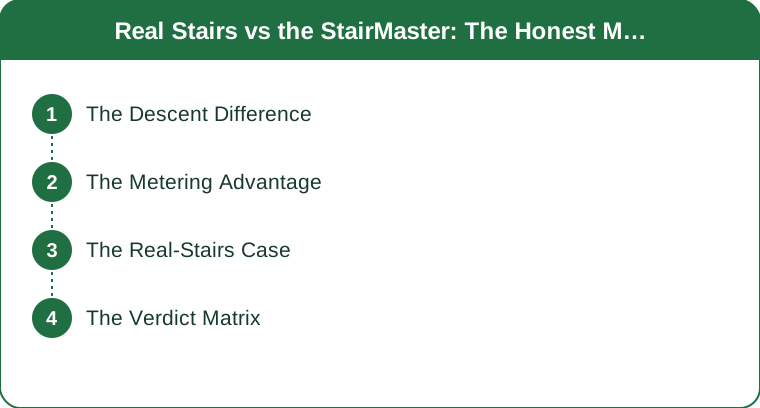
What’s the real difference between stairs and a StairMaster?
The descent. Everything else is logistics.
Real stairs make you come back down, and descending is eccentric quad work — your quads lengthening under load to control each landing. That’s a genuinely different stimulus from climbing, and it’s the specific quality that hiking, trail running, and any downhill sport demands. It’s also what makes your legs hurt for two days afterward if you’re not used to it.
The StairMaster has no descent at all. The steps disappear under you and reset, so you climb forever without ever coming down. That makes it substantially kinder to knees — descent is where most knee complaints originate, since it produces the highest joint forces — and it makes it incomplete for anyone training for a hike.
That single difference is the decision criterion for most people. Cranky knees? The machine. Training for a mountain? Real stairs, including the way down.
What does the StairMaster do better?
Metering, mostly, and it’s a bigger advantage than it sounds.
- Precise pacing. Steps per minute dialed to an exact number means intervals actually run on data. “4 minutes at 70 spm, 2 minutes at 45, repeat five times” is a real protocol you can repeat and progress. Real stairs give you a stairwell and your best guess.
- No logistics. No door codes, no residents wondering what you’re doing on floor 7, no closed stairwells, no negotiating with people carrying groceries.
- Weather immunity. February exists. Stadium stairs in February mostly don’t.
- Trackable progression. Weeks and months of numbers you can compare. The benchmark culture around the machine — climbing a set number of floors at a set pace — gives people something concrete to chase.
- Entertainment compatibility. A 30-minute climb goes considerably faster with something on the screen, and that’s a legitimate adherence argument.
Progression tracks cleanly when the mountain comes with a console.

What do real stairs do better?
Four things, and the first one is free.
Cost. Zero, forever. No membership, no equipment, and every building has some.
Stabilizer demand. Real steps have inconsistent depth, varying rise, and no handrails to lean on. Your ankles, hips, and core work considerably harder to keep you balanced. The machine’s rails erase that demand entirely — and most people use them.
The descent. As above, this is eccentric training you can’t buy on a machine. If you hike, ski, or run trails, it’s not optional.
Fresh air. Stadium stairs, park stairs, and outdoor staircases in summer are genuinely pleasant in a way that no gym cardio deck manages.
Honesty. This is the underrated one. On real stairs, you can’t quietly reduce the resistance and tell yourself you’re still working. The stairs are exactly as tall as they were five minutes ago.
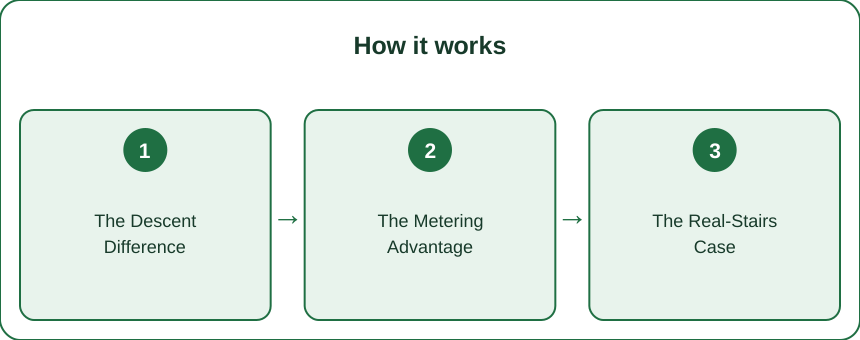
5 Mistakes Everyone Makes
- Draping your bodyweight on the handrails. The single biggest error in stair training. Leaning on the rails can cut the actual work by something like a third to a half — you’re supporting your weight with your arms and calling it leg cardio. Fingertips for balance only, or hands completely off. If you can’t maintain the pace without leaning, the pace is too high.
- Taking two steps at a time by default. It shifts the work toward the glutes, which is fine occasionally, but it also increases knee load significantly. Alternate rather than living there.
- Skipping the descent entirely on real stairs. Taking the elevator down removes the eccentric benefit, which is half the reason you chose real stairs. If your knees can’t handle descending, that’s a reason to use the machine, not to skip the stairs half of stairs.
- Landing hard on the balls of the feet only. Full foot contact where the step depth allows. Toe-only climbing torches your calves and does nothing extra for your legs or lungs.
- Starting at 20 minutes. Stair climbing is deceptively hard on the cardiovascular system. Start at 10 minutes and add 2–3 minutes weekly. Your first stadium session should end while you still feel fine.
The verdict matrix
Machine for: metered intervals, knee-protective climbing, winter, tracked progression.
Real stairs for: hiking prep, stabilizer work, budget, daylight, descent training.
The hybrid year is the connoisseur’s answer — machine in winter, stadium in summer. And the hands-off-the-rails rule governs both venues equally.
Wear something that doesn’t need adjusting mid-climb; stair work involves a lot of hip flexion, so squat-proof high waist leggings beat anything that migrates. And shoes with real cushioning matter more on real stairs, where the descent lands repeatedly on concrete.
FAQ
Is the StairMaster better than real stairs?
Neither is better overall — they’re better at different things. The machine offers precise pacing, weather immunity, and no descent, which suits interval work and sensitive knees. Real stairs are free, demand more stabilizer work, and include the eccentric descent that hiking preparation requires.
How long should a stair workout be?
Start at 10–15 minutes and build toward 20–30. Stair climbing raises heart rate faster than most cardio, so 20 focused minutes with hands off the rails is a substantial session. Interval formats — 1 minute hard, 1 minute easy — work well from about the third week.
Does the StairMaster build muscle?
It builds endurance in the glutes, quads, and calves, and will add some muscle for a beginner, but it’s primarily cardio. For real leg muscle growth you need progressive resistance training — squats, lunges, hinges — with the stair work supporting conditioning rather than replacing the strength work.
TL;DR:
- The core difference is the descent: real stairs give eccentric quad work, the machine gives none.
- Machine wins on pacing precision, weather, tracking, and knee comfort.
- Real stairs win on cost, stabilizer demand, fresh air, and hiking specificity.
- Hands off the rails at both venues — leaning can erase a third or more of the work.
- Start at 10 minutes and build 2–3 minutes a week. Machine in winter, stadium in summer.
Keep Reading
This article is for general informational and styling purposes only. Fit, sizing, and product availability may vary.