Why Real Stairs Beat the StairMaster and When They Do Not
Quick Answer: The difference is the descent. Real stairs make you climb and come back down, and the down half is eccentric work — muscles lengthening under load — which builds control, bone density, and the soreness resilience machines never touch. The StairMaster deletes the descent, which is exactly why it is gentler on cranky knees, steadier for pure cardio zones, and easier to dose precisely. Neither is the better tool universally: outdoor stairs build the more complete athlete, the machine builds the more controlled session. The honest answer is knowing which job you are hiring for today.
The way down is not the rest. It is the half the machine cannot sell you.

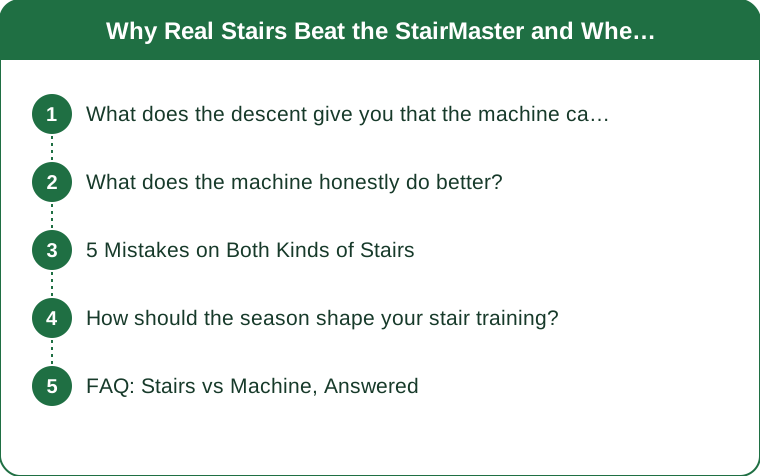
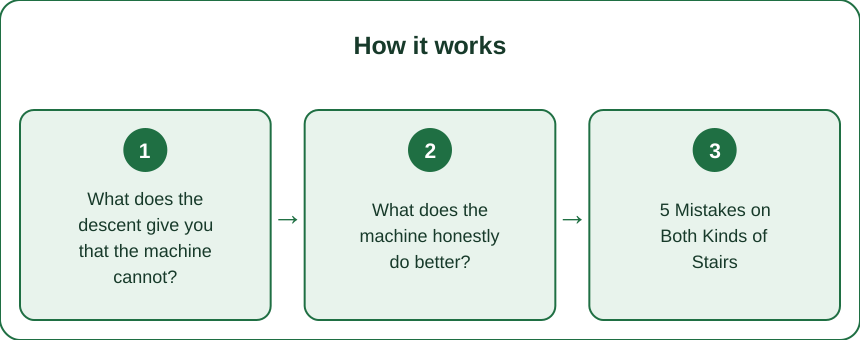
What does the descent give you that the machine cannot?
Eccentric loading — and eccentric loading is quietly one of the most valuable stimuli in training.
Climbing is concentric work: muscles shortening as they produce force. Descending reverses it — your quads and glutes lengthen under load, braking your bodyweight against gravity step after step. It feels easy because the cardiovascular cost is low, and that feeling misleads: eccentric contractions produce more muscle tension per effort than concentric ones, which is why the descent you barely noticed is what your thighs report for two days afterward.
That delayed soreness is the signature of a stimulus doing rare work:
Braking strength and control. The ability to decelerate your own bodyweight is the difference between absorbing a misstep and rolling an ankle, and almost nothing in gym cardio trains it. Downhill control is a skill, built only by going down things.
Impact your skeleton can bank. Each descending step delivers a modest, repeated loading pulse — exactly the stimulus bone remodeling responds to. The StairMaster’s smooth glide is precisely engineered to remove it.
Soreness resilience. The repeated bout effect means eccentric work you do regularly stops making you sore within a couple of exposures — protection that transfers to hiking, sports, and long sightseeing days. People who only ever climb machines discover this gap on vacation, three flights down from the viewpoint.
Add the unmeasured extras — balance on imperfect surfaces, no handrails silently carrying part of your bodyweight, weather, daylight — and a stadium session is training more systems than its step count shows. The machine counts floors. The stairs charge for both directions.
What does the machine honestly do better?
Dosage, joint mercy, and uninterrupted cardio — three real advantages that outdoor purists undersell.
Continuous pacing. Real stairs impose an interval structure whether you want one or not: climb, turn, descend, repeat. The StairMaster delivers unbroken climbing at an exact rate for thirty steady minutes, which makes it the superior tool for sustained zone two aerobic work and for precise interval prescriptions. There is no turnaround, no traffic, no dead time.
A descent free option for cranky knees. The eccentric loading that makes real stairs valuable is also exactly what aggravates certain knee conditions — descending loads the kneecap joint hard, and for people managing that specific complaint, all the climbing benefit with none of the downhill cost is not a compromise, it is the entire prescription. Same logic applies when returning from injury: the machine lets you buy the cardio while rationing the impact.
Control of every variable. Step rate, session length, progression week over week — all dialed, all repeatable, all logged. Rain, darkness, heat waves, and the ice of a February morning are not consulted.
Two machine caveats keep it honest. The handrail lean is the great StairMaster tax dodge: locked elbows propping up bodyweight can offload a meaningful share of the work while the console credits you the full amount. Fingertips for balance only. And the hunched phone posture — forearms on the console, hips pushed back — turns a climbing session into a strange crouch. Eyes up, hips under shoulders, and the machine gives what it promised.
The clean split: hire the machine for controlled cardio volume and descent free days. Hire the stairs for strength, bone, control, and everything the outdoors adds.

5 Mistakes on Both Kinds of Stairs
1. Leaning on rails — machine or stadium. On the StairMaster it deletes a chunk of the workload; on real stairs it robs the balance training. Hands hover or touch lightly; the legs do the job. Exception: genuine stability concerns, where the rail is safety equipment and belongs in the plan.
2. Toes only strike on the way up. Climbing on the ball of the foot with the heel never settling overloads calves and Achilles — the classic first week soreness surprise. Get most of the foot on each step and drive through the whole foot, especially on deep stadium steps.
3. Treating the descent as junk time. Bombing down loose and sloppy wastes the eccentric gold and is where the ankle rolls live. Come down deliberately: controlled pace, feet landing quietly, weight mid foot. Quiet feet are the audit — noisy descent means braking with joints instead of muscles.
4. Racing strangers and skipping steps on day one. Doubles and sprint flights are legitimate progressions — after a base of singles at conversational effort. The ego session on week one writes checks the stair muscles cannot cash, and stair DOMS from unaccustomed eccentric work is genuinely humbling.
5. Wearing the wrong grip. Smooth worn soles on smooth worn stadium concrete, or cushioned max stack trainers that wobble on step edges — both are avoidable slips. A flat stable shoe with honest tread, and fitted bottoms that do not catch a heel — leggings or joggers with a cuff, never wide open hems on the descent.
How should the season shape your stair training?
Late summer says go early and outside; the coming months say build the habit before the weather votes.
Right now the outdoor window is morning. August stadium concrete stores afternoon heat impressively, and a shade free stair set at 5pm is a cardio session plus a griddle. Early sessions get cooler air, empty stairs, and the season’s best light — and outdoor stairs plus a water bottle need no membership at all, which keeps the whole habit free.
September and October are the payoff months. Crisp mornings, dry steps, and the exact daylight stair training photographs itself in — this is the season to shift serious sessions outdoors and pocket the eccentric benefits while conditions are perfect. It is also when the repeated bout effect earns its keep: build the descent tolerance now and the fall hiking trips, the leaf peeping walks, and the stadium tailgates all arrive pre trained.
Then the weather starts voting. Wet leaves on outdoor steps are genuinely slick, early dark compresses the safe window, and the first frost turns concrete edges hostile. The smart structure is a hybrid built in advance: outdoor sessions while conditions allow, StairMaster as the standing indoor backup so bad weeks bend the plan instead of breaking it. People with an indoor fallback train through November; people without one stop at the first cold rain.
Safety keeps its year round seat: stairs demand more attention than flat cardio, so music low enough to hear surroundings, hands free of the phone mid flight, and daylight or well lit sessions when solo. And anyone with heart conditions, significant knee history, or balance concerns should size stair work with their clinician — it is one of the more intense cardio formats per minute, which is precisely its appeal and its caveat.
FAQ: Stairs vs Machine, Answered
Which burns more calories?
At matched effort they are close — climbing is climbing. Real stairs often win per session because descents keep muscles working while heart rate recovers, and outdoor sessions tend to run more honest without a console to negotiate with. But the machine’s uninterrupted pace can stack more climbing minutes per half hour. Effort and consistency decide it, not the venue.
Why do my legs hurt two days after stadium stairs but never after the StairMaster?
That is the descent — delayed onset soreness from eccentric loading the machine never gives you. It fades to nothing within a couple of weekly exposures, which is the repeated bout effect doing its job. Start with modest volume and the toll is mild.
Are stairs bad for knees?
Healthy knees adapt well to progressive stair work in both directions — the loading is a stimulus, not a sentence. Existing kneecap pain often objects specifically to descents, which is exactly when the StairMaster’s climb only format is the right tool while things settle. Persistent pain either way is a professional conversation, not a toughness test.
How do I start if I have not trained stairs at all?
Two short sessions a week: ten to fifteen minutes of single steps at conversational pace, deliberate descents, two days of recovery after the first one — respect the eccentric soreness once and it largely never returns. Add flights, then pace, then doubles, in that order, over a month.
TL;DR:
- Real stairs charge both directions: climbing builds the engine, and the descent’s eccentric loading builds braking strength, bone stimulus, and soreness resistance.
- The StairMaster deletes the descent — which is its weakness for completeness and its superpower for cranky knees and uninterrupted zone work.
- On both: no rail leaning, whole foot strikes, deliberate quiet descents, and progression before ego.
- Train outdoors in the cool mornings now and through the perfect fall window, with the machine as the standing bad weather backup.
Find one good staircase this week and do fifteen honest minutes, both directions. The soreness two days later is the half of the workout you have been missing.
Keep Reading
This article is for general informational and styling purposes only. Fit, sizing, and product availability may vary.