Why Descending Stairs Can Feel Surprisingly Harder on the Legs Than Climbing Them for Beginners
Quick Answer: Going down stairs makes your legs sorer than going up because descending is eccentric work — your quads lengthen under load to control each step, and eccentric contractions cause far more muscle damage and delayed soreness than the concentric work of climbing. Build descent tolerance separately: start with 2–3 flights down, add roughly 10–20% per week.
You expected the climb to be the hard part. It was, in the moment.
Then you woke up two days later and going down the stairs to the kitchen was the problem. That’s not a coincidence, and it’s not a sign you’re out of shape.

What’s the Difference Between Climbing and Descending Stairs?
Two entirely different kinds of muscle contraction.
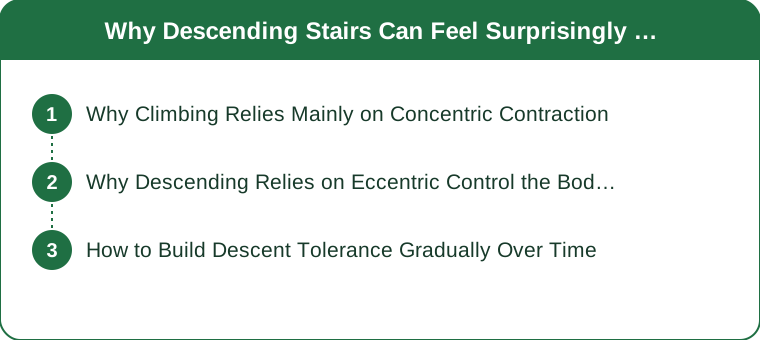
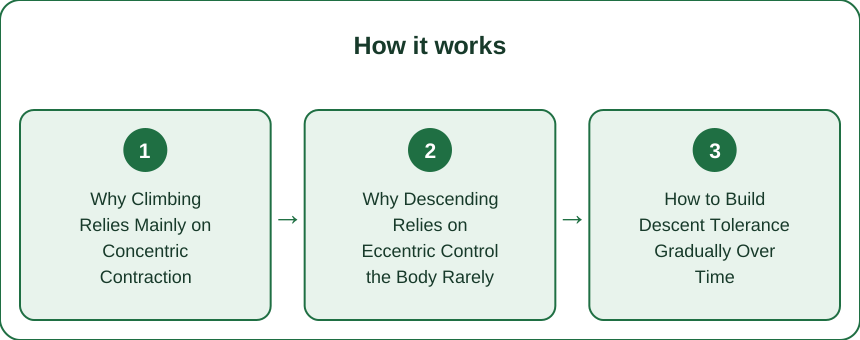
Climbing is concentric. Your quads and glutes shorten to produce force and lift your body against gravity. It’s metabolically expensive — you’re doing positive work — which is why you’re breathing hard. Your cardiovascular system is the limiting factor, and that’s the effort you feel in the moment.
Descending is eccentric. Your quads lengthen while still generating force, acting as a brake to control your body’s fall onto the next step. You’re absorbing energy rather than producing it.
The energy cost tells the story: descending burns roughly one-third the calories of climbing the same flight. Objectively, less effort. Which is exactly why it’s confusing that it hurts more later.

Why Does Eccentric Work Cause More Soreness?
Because braking a load with a lengthening muscle puts high tension on fewer active fibers.
During an eccentric contraction, the muscle recruits fewer motor units to handle the same force. Each active fiber therefore carries more mechanical stress, and that produces more microscopic damage to the fiber structure. The subsequent inflammatory repair response is what you feel as delayed onset muscle soreness (DOMS), which typically peaks 24–48 hours later.
That’s the delay you experienced. The workout ended Tuesday evening feeling fine; the soreness peaked Thursday morning.
There’s a second layer: untrained muscles are dramatically more vulnerable to this. Eccentric-heavy work in someone with no eccentric training history produces disproportionate soreness. The good news is that the adaptation is fast and durable — the “repeated bout effect” means one hard eccentric session substantially protects you against the next, sometimes for weeks.
So the first big descent day is by far the worst one you’ll have. It gets better quickly.
How Do You Build Stair Descent Tolerance?
Treat the descent as its own training variable rather than assuming it comes along with climbing.
Start conservatively. If you’re new to stair work, descend 2–3 flights per session, not fifteen. Take the elevator down for the rest, which feels like cheating and is actually the correct decision in week one.
Progress about 10–20% per week. From 3 flights down, go to 4, then 5. Eccentric tolerance builds fast but it needs to be built, not assumed.
Track climb and descent volume separately in your log. They adapt at different rates, and a single “flights” number hides the variable that’s actually making you sore.
Descend with technique that reduces impact:
- Land on the ball of the foot first, then let the heel settle — flat-footed landings send a spike straight up the leg
- Keep a slight bend in the knee; a locked-out leg passes force into the joint instead of the muscle
- Use the handrail on longer descents. It’s not a weakness signal; it offloads real force
- Shorten your steps rather than lengthening them. One stair at a time, controlled
And a genuinely useful reframe: eccentric loading is one of the more effective stimuli for building strength and tendon resilience. The soreness isn’t the training failing — it’s the beginning of an adaptation that’s worth having. You just want to arrive at it gradually.
The 5 Mistakes New Stair Climbers Make
- Descending as fast as they climbed. Speed multiplies the impact force your quads have to absorb per step.
- Doing a huge first session. Twenty flights up and twenty flights down on day one produces soreness that ends the habit by Friday.
- Landing heel-first and flat. Higher peak force, less muscular absorption, more joint loading.
- Ignoring the handrail on the way down. It measurably reduces the load your legs are braking, especially on steep or uneven stairs.
- Training through peak DOMS. Going hard again at hour 36, when soreness is peaking and force production is measurably reduced, is where minor injuries happen. Give it 48 hours or go light.
FAQ
How long does stair-climbing soreness last?
DOMS from eccentric work typically appears 12–24 hours after the session, peaks around 24–48 hours, and resolves within 3–5 days. If soreness lasts beyond a week, is sharply localized to one point rather than diffuse, or comes with swelling or dark urine, that’s worth getting checked by a doctor rather than waiting out.
Should I take the elevator down when I’m starting out?
Yes, and it’s a legitimate strategy rather than a compromise — climbing gives you most of the cardiovascular benefit, and descending is where nearly all the soreness comes from. Ride down for the first couple of weeks and add descent volume deliberately once the climbing feels manageable.
Is descending stairs bad for your knees?
Descending does load the knee joint more than climbing, with peak forces several times body weight. For healthy knees that’s a normal, tolerable load that builds resilience when introduced gradually — but if you have existing knee pain, patellofemoral issues, or arthritis, use the handrail, shorten your steps, and talk to a physical therapist about volume before ramping up.
General fitness information, not medical advice. Stop and seek medical guidance for sharp joint pain, swelling, or pain that doesn’t improve within a week.
TL;DR:
- Climbing is concentric (muscles shorten, high energy cost); descending is eccentric (muscles brake while lengthening)
- Eccentric work spreads high tension across fewer fibers, causing more microdamage and more DOMS at 24–48 hours
- Descending burns about a third the calories of climbing but causes most of the soreness
- Build descent volume separately: start at 2–3 flights, progress 10–20% weekly
- Land ball-of-foot first, keep a soft knee, use the handrail, and don’t train hard again at peak soreness
Keep Reading
This article is for general informational and styling purposes only. Fit, sizing, and product availability may vary.