Why Stair Climbing Feels Harder Than Running at the Same Heart Rate
Quick Answer: Stair climbing is almost entirely concentric, uses a smaller working muscle mass at higher relative intensity, and involves lifting your full body weight vertically against gravity every step. Running distributes work across a longer stride and reuses elastic energy from the tendons; stairs don’t. So at the same heart rate, stairs produce far more local muscular fatigue in the quads and glutes.
You run 5K comfortably. Ten flights of stairs and your legs are burning while your breathing hasn’t even caught up. That mismatch is real and it tells you something useful about what stairs are good for.

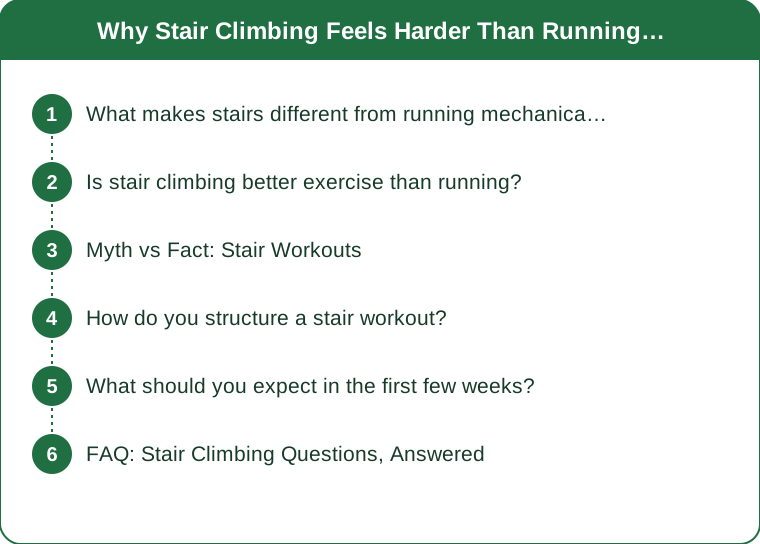
What makes stairs different from running mechanically?
Three things, and they compound.
Vertical work versus horizontal work. Running forward on flat ground involves modest vertical displacement per stride. Climbing raises your entire body mass by the height of each step — roughly 7 inches — every single step. That’s mechanical work with no way around it.
No elastic return. Running stores energy in the Achilles tendon and calf during landing and returns a meaningful share of it in push-off. Stair climbing has almost no eccentric loading phase on the way up, so there’s no stored energy to recover. Every step is paid for fresh.
Smaller working muscle mass at higher intensity. Running distributes load across a longer chain with more sharing between muscle groups. Stairs concentrate demand into the quadriceps and glutes at high force per contraction, which means those specific muscles hit local fatigue while your cardiovascular system is still comfortable.
That last point explains the specific sensation: your legs quit before your lungs do. It’s a local muscular endurance limit, not a cardiovascular one.
Is stair climbing better exercise than running?
Different, not better — and the differences are useful to know.
Stairs are better for: building lower-body muscular endurance, training at high intensity in a short time, low-impact loading (going up has much lower joint impact than running), and training in limited space or bad weather.
Running is better for: total calorie expenditure over long durations, aerobic base building, bone density from impact loading, and sport-specific transfer to most endurance activities.
Energy cost per minute favors stairs significantly. Vertical climbing is one of the highest-intensity activities available without equipment. Ten minutes of continuous stair climbing is genuinely demanding for most people.
Impact favors stairs on the way up and disfavors them on the way down. Descending involves substantial eccentric loading on the quadriceps and knee joint — it’s where most stair-related soreness and most stair-related knee complaints originate.
The practical implication: if you’re using stairs for training, consider taking the elevator down. Ascending gives you the training stimulus; descending gives you most of the joint stress and the delayed soreness.
Myth vs Fact: Stair Workouts
Myth: Taking stairs two at a time is just showing off. Fact: It changes the exercise meaningfully — longer range of motion, more hip extension, more glute involvement, and higher force per step. It’s a different stimulus, closer to a step-up than a climb. It also increases fall risk and knee load, so it’s a choice rather than an upgrade.
Myth: Holding the handrail cheats the workout. Fact: Light balance contact changes little. Actively pulling yourself up transfers real load to the arms and reduces leg work — that’s the version that reduces the stimulus. If you need the rail for safety, use it; just keep the grip light.
Myth: Stairs are bad for your knees. Fact: Ascending stairs is generally well tolerated and is often included in knee rehabilitation. Descending is the higher-load direction. Existing knee pain warrants a professional opinion, but stairs aren’t inherently harmful.
Myth: The stair machine is the same as real stairs. Fact: Close, but the machine’s moving steps reduce the need to decelerate and stabilize, and there’s no descent phase. It’s a good substitute with slightly less demand.
Myth: You need a long stairwell to get a workout. Fact: One flight repeated is enough. The limiting factor is total vertical distance, not the height of the individual stairwell.

How do you structure a stair workout?
Three formats cover almost every goal.
Steady climb (aerobic): 15 to 25 minutes of continuous climbing at a pace you could hold a conversation at, riding down between flights if it’s a building. Builds aerobic capacity with low impact.
Intervals (high intensity): 30 to 60 seconds of hard climbing, 90 seconds recovery, repeated 6 to 10 times. This is the format that produces the most fitness improvement per minute and the one stairs are genuinely best at.
Strength endurance: two-at-a-time climbing for 20 to 30 seconds, full recovery, 8 to 12 sets. More like a lower-body strength session than cardio.
Progression is simple: add flights, then add sets, then reduce rest — in that order. Adding speed before volume is where injuries show up.
Warm-up matters more than it does for walking. Five minutes of easy movement plus a slow first flight; the quads go from cold to high demand within seconds otherwise.
A realistic starting point for someone new to it: 5 rounds of one minute up, two minutes recovery, twice a week. That’s under 20 minutes and produces measurable change within a month.
What should you expect in the first few weeks?
A steep adaptation curve, then a plateau that’s worth pushing through.
Week 1 to 2: Significant soreness, particularly in the quadriceps, mostly from descending. Perceived difficulty drops fast because a lot of the early improvement is neuromuscular efficiency rather than fitness.
Week 3 to 6: Real aerobic and muscular endurance adaptations. Same workout feels substantially easier. This is where most people either progress or stop finding it challenging and quit.
Beyond 6 weeks: Progression requires added load — more flights, added weight in a pack, or faster intervals. Bodyweight climbing at a fixed volume stops producing change.
Watch for: knee discomfort on descent (take the elevator down or slow the descent significantly), and calf tightness (stairs load the calves hard and they respond well to consistent stretching).
A note on carrying weight: adding a loaded pack is the most effective progression and also the fastest route to knee irritation if added quickly. Start at 5 to 10 percent of body weight and increase slowly.
This is general information, not medical advice. If you have existing knee, hip, or cardiovascular conditions, check with a professional before starting a stair program.
FAQ: Stair Climbing Questions, Answered
How many flights equal a mile of running?
There’s no clean conversion, but by energy cost roughly 10 to 15 minutes of steady stair climbing is comparable to a moderate mile. Vertical work is expensive, so the time required is much shorter than the distance intuition suggests.
Should I go up on my toes or with a full foot?
Full foot contact where the step allows — it engages the glutes and hamstrings more and reduces calf-only fatigue. Toe-only climbing loads the calves heavily and tires you out faster without a corresponding benefit.
Is it safe to do stairs every day?
Ascending, generally yes at moderate volume. Daily high-intensity stair intervals is too much for most people — the quads need recovery. Two to three hard sessions per week with easy movement in between is a sustainable structure.
TL;DR:
- Stairs are almost entirely concentric with no elastic energy return, so leg fatigue outpaces cardiovascular fatigue.
- Ascending is low-impact and the training stimulus; descending causes most soreness and joint load.
- Intervals — 1 minute up, 2 minutes recovery, 6–10 rounds — are what stairs do best.
- After ~6 weeks, progression needs added flights, speed, or load.
The burning-legs-but-easy-breathing sensation isn’t a sign you’re unfit. It’s the signature of a concentric, high-force, small-muscle-mass exercise — and it’s exactly why stairs build something running doesn’t.
Keep Reading
This article is for general informational and styling purposes only. Fit, sizing, and product availability may vary.