Why Stair Workouts Feel Easier Going Up Than Coming Down the Next Day
Quick Answer: Going up is concentric work — hard on your lungs and heart, but relatively gentle on muscle tissue. Coming down is eccentric — your quads lengthen under load to control each step, which causes far more muscle damage. That is why the easy-feeling part produces the soreness that peaks 24 to 72 hours later. Build descent volume gradually, or take the lift down while you adapt.
Up was the part that hurt.
Down was the part that felt like a break.
Two days later your quads disagree completely.

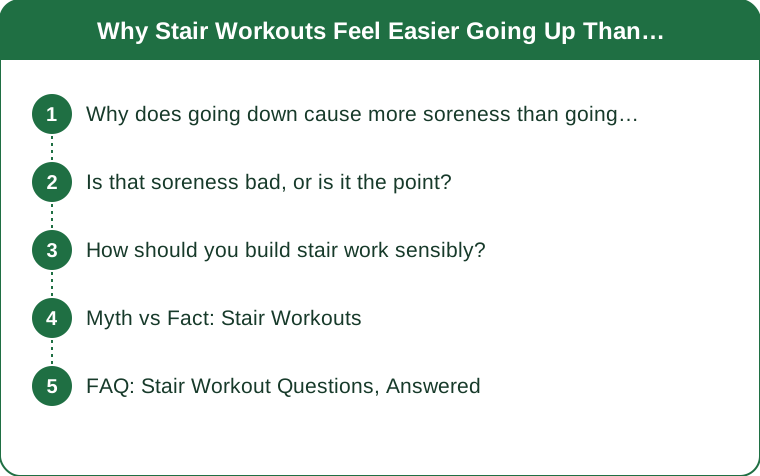
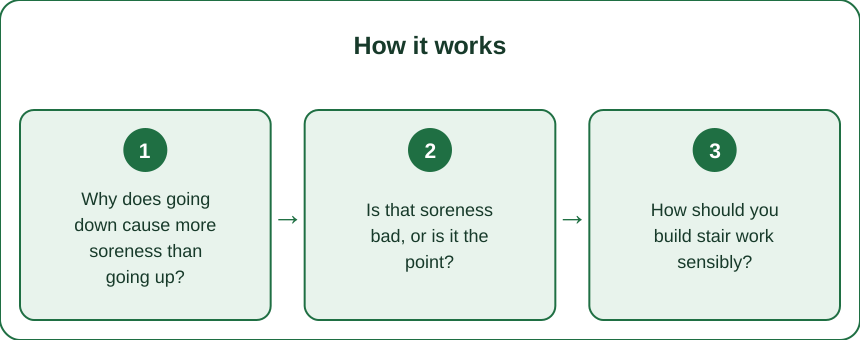
Why does going down cause more soreness than going up?
Because of the type of contraction, not the effort.
Going up is concentric — muscles shorten to produce force. Metabolically expensive, hard on the cardiovascular system, and relatively low in mechanical damage.
Going down is eccentric — muscles lengthen while resisting. Your quads are controlling a descent against gravity, and lengthening under load produces far more microtrauma than shortening does.
Eccentric work uses fewer motor units for the same force. The load is concentrated on less tissue, which increases stress per fibre.
And it costs less energy. Eccentric contractions use substantially less oxygen for the same force, which is exactly why descending feels easy while doing more structural damage. Your perception is tracking energy cost, not tissue load.
Delayed onset is the signature. Soreness peaking at 24 to 72 hours is characteristic of eccentric damage, and it is why the connection to the descent so often goes unnoticed.
Which flips the usual mental model: the climb trains your cardiovascular system, the descent trains and damages your muscles. They are two different workouts happening in the same session.
Is that soreness bad, or is it the point?
Mostly the point — eccentric work is genuinely valuable when dosed properly.
Eccentric training builds strength effectively. It is one of the more potent stimuli for strength and for tendon adaptation, which is why it appears throughout rehabilitation protocols.
It builds the specific control you need for descending. Downhill walking, hiking and stairs all demand eccentric quad strength, and the only way to build it is to do it.
The repeated bout effect is strong and fast. After one properly sore session, the same workout produces dramatically less soreness the next time — and that protection lasts for weeks.
But the first exposure is easy to overdo. Descending forty flights on day one produces soreness that can genuinely limit you for three to five days, and it is entirely avoidable.
Excessive damage is worth avoiding. Very severe soreness after unaccustomed eccentric work is not a badge — in rare extreme cases, particularly combined with dehydration and heat, unaccustomed eccentric exercise can cause serious muscle breakdown.
The practical marker: soreness that makes stairs awkward for a couple of days is normal adaptation. Soreness that prevents normal walking, or dark-coloured urine, means stop and seek medical advice.
This is general information, not medical advice.

How should you build stair work sensibly?
Six rules for getting the benefit without the three-day limp.
Take the lift down for the first two weeks. The most effective single strategy. Climb, descend by lift, and let your cardiovascular system adapt before you introduce the eccentric load.
Then add descents gradually. Start with descending one flight in four, then half, then all. The repeated bout effect means each step is easier than the last.
Control the descent deliberately. Landing softly, using the whole foot, and keeping a slight knee bend spreads the load. Slapping down flat-footed and locking out concentrates it.
Shorten your stride going down. Smaller steps mean less eccentric range per step and considerably less damage.
Use the handrail on the descent, not on the climb. Slight support on the way down measurably reduces quad loading. Using it on the way up just reduces the training effect.
Allow 48 hours between hard descent sessions initially. Once adapted, most people can handle stairs several times a week without issue.
Seasonal note: outdoor stairs in autumn add two variables — wet leaves and damp stone are genuinely slippery, and cold quads take eccentric load worse than warm ones. Walk the first flight before running anything, and be more conservative on descents than you would be in July.
Myth vs Fact: Stair Workouts
Myth: going down is the recovery portion. Fact: it is the muscle-damaging portion. It feels easier because it costs less energy, not because it does less work.
Myth: soreness means a good workout. Fact: soreness mostly means an unaccustomed workout. It correlates with novelty far more than with training effect.
Myth: stretching prevents the soreness. Fact: stretching before or after does not meaningfully prevent delayed onset soreness from eccentric work. Gradual exposure does.
Myth: you should rest completely until it passes. Fact: gentle movement and light activity generally ease it faster than complete rest.
Myth: stairs are bad for your knees. Fact: for most healthy knees, they build strength. Descending loads the knee more than ascending, so anyone with knee issues should build descent volume especially carefully — and existing knee pain warrants professional assessment first.
Myth: the soreness gets worse as you get fitter. Fact: the opposite. The repeated bout effect means the second and third exposures produce dramatically less soreness, and it protects you for weeks.
Myth: stair climbing is only cardio. Fact: it is a genuine lower-body strength stimulus, particularly on the descent, which is why it produces soreness that pure cycling never does.
FAQ: Stair Workout Questions, Answered
Why are my quads sore and not my calves?
Descending is quad-dominant eccentric work. The calves do more of the climbing; the quads do the braking.
How long does the soreness last?
Peaks at 24 to 72 hours and generally resolves within five days. Much less on subsequent exposures.
Should I take the lift down?
For the first couple of weeks, yes. It lets you build the cardiovascular side without the eccentric damage.
How do I descend with less damage?
Shorter strides, soft controlled landings, a slight knee bend, and light handrail use.
Is stair climbing bad for knees?
Generally strengthening for healthy knees. Descending loads them more, so build that gradually. Existing knee pain warrants assessment first.
How often can I do stairs?
Allow 48 hours between hard descent sessions at first. Once adapted, several times a week is fine for most people.
When should soreness worry me?
If it prevents normal walking, lasts beyond a week, or comes with swelling or dark urine. Those warrant medical advice rather than patience.
TL;DR:
- Climbing is concentric — hard on lungs, gentle on tissue. Descending is eccentric — easy-feeling, far more damaging.
- Descent soreness peaks at 24 to 72 hours, which is why the connection gets missed.
- Take the lift down for the first two weeks, then add descents gradually.
- Shorter strides, soft landings and handrail support on the way down cut the damage substantially.
- The repeated bout effect is strong — the second session is dramatically less sore than the first.
Next session, climb as usual and take the lift down. Your quads will thank you on Thursday.
Keep Reading
This article is for general informational and styling purposes only. Fit, sizing, and product availability may vary.