Why the Last Flight Is Where Form Breaks and Injuries Happen
Quick Answer: Fatigue degrades foot clearance before it degrades strength. By the final flight, hip flexor fatigue reduces how high you lift your foot by a couple of centimetres, which is more than enough to catch a step edge. At the same time eccentric control on the descent has faded, so your ability to recover from a stumble is at its lowest exactly when the risk of stumbling is at its highest. Finish one flight earlier than you want to.
The last flight is the one your session should not include.
This blog has covered why stair climbing feels harder on the way down, knee pain and descent mechanics, and why outdoor stair workouts get riskier once leaves start falling. This is where those combine.

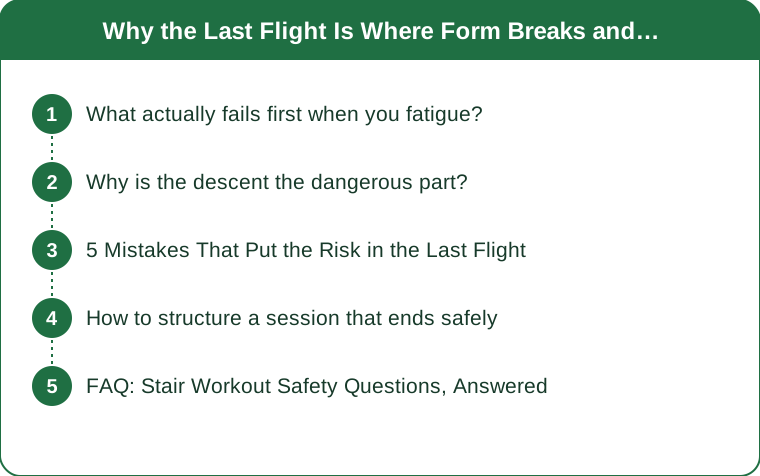
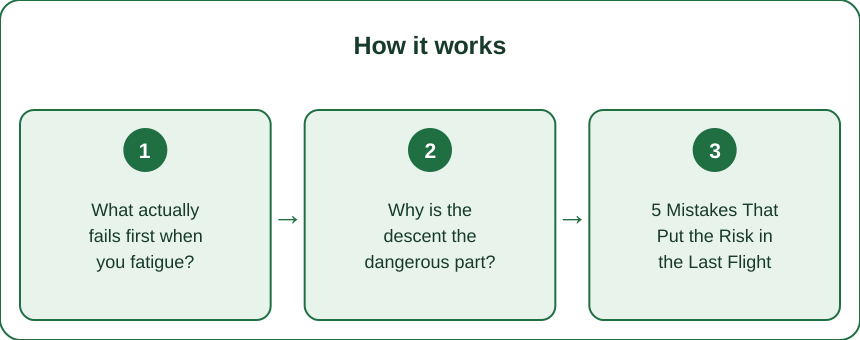
What actually fails first when you fatigue?
Foot clearance, not leg strength — which is why it surprises people.
Stair climbing requires you to lift your foot above the step edge every single stride, and the margin is small: typically two to three centimetres of clearance.
Hip flexors fatigue before quadriceps and glutes in repetitive stair work, and hip flexion is what generates that clearance.
A two-centimetre reduction in toe clearance is enough to catch a step edge, and it happens without any conscious sense that your stride has changed.
Trip risk therefore rises sharply in the last portion of a session even though you can still produce plenty of force.
Descending is worse. Foot placement precision matters more going down, and vision is doing more of the work.
And your recovery capacity is falling at the same time. Catching yourself after a stumble requires a fast, forceful eccentric response, which is precisely what fatigue removes first.
Why is the descent the dangerous part?
Because it loads eccentrically, and eccentric control degrades faster than concentric strength.
Going down is eccentric work for the quadriceps — the muscle lengthening under load — which produces more muscle damage and more delayed soreness than going up.
Peak knee joint forces on descent are substantially higher than on ascent, which is why descent, not ascent, is what aggravates knee complaints.
Eccentric control fades quickly under fatigue. A tired quadriceps lowers you less smoothly, which effectively increases impact on each step.
Descent speed tends to increase as you tire, because controlling the descent costs energy and letting gravity do more feels easier.
Vision is doing more of the work going down, and in autumn that means low sun, longer shadows and less light generally.
And this is where surface conditions bite. Wet leaves, frost and moss on outdoor steps are almost exclusively a descent problem, and they arrive at the same time of year that the light gets worse.

5 Mistakes That Put the Risk in the Last Flight
All of them are about how the session is structured, not how fit you are.
Mistake one: planning to failure. Finishing a stair session at the point where you can barely continue means your final descent happens at your worst possible state. Finish one flight before that point, every time.
Mistake two: descending fast because it feels easy. It is not easy on the joints, and it is where the injuries are. Descend deliberately, and take the handrail when tired — it does not meaningfully reduce the training effect on the way down.
Mistake three: taking two steps at a time when tired. Double-stepping requires substantially more hip flexion and clearance, which is exactly the capacity that has faded. Save it for the early flights if you use it at all.
Mistake four: outdoor stairs in low light in autumn. Depth perception on steps depends heavily on seeing the edges, and low autumn sun plus wet leaves removes that. Move to indoor stairs or an earlier time slot.
Mistake five: no cool-down flight. A final slow, deliberate flight at low effort reduces the chance of the last real descent being the ragged one.
The bonus mistake: increasing volume by more than about 10 percent a week. Stair work loads the Achilles, patellar tendon and calf heavily, and these tissues adapt more slowly than your cardiovascular system improves — which is why the fitness gets there long before the tissue does.
How to structure a session that ends safely
Build the ending into the plan rather than stopping when you run out.
Decide your flight count before you start and finish one below your maximum. Sessions that end at a planned number end cleanly; sessions that end at exhaustion end badly.
Put the hardest efforts in the middle third, not at the end. Ending on an all-out effort guarantees your worst descent.
Use the elevator or a lift down for the final descent on a genuinely hard session if one is available. This is not cheating; it removes the highest-risk portion.
Descend one step at a time, whole foot on the step where the depth allows, and use the rail when tired.
Do a deliberate final flight at conversational effort as a cool-down, which restores movement quality before you leave.
Wear shoes with a defined heel and reasonable grip, not minimalist or worn-smooth soles. Step edges demand traction and a shoe you can feel.
And check the surface before you start on outdoor steps. Ten seconds looking at the descent tells you whether the leaves, damp or frost make today an indoor day.
FAQ: Stair Workout Safety Questions, Answered
Why do I stumble on stairs only at the end of a workout?
Because hip flexors fatigue before your bigger leg muscles, and hip flexion is what produces the two to three centimetres of foot clearance you need over each step edge. Strength is still there; clearance is not, and you cannot feel the difference.
Is going down stairs harder on your knees than going up?
Yes. Descent is eccentric work with substantially higher peak knee joint forces, which is why knee complaints in stair training almost always relate to the descent rather than the climb. Descending deliberately and using the handrail when tired both help.
How should I end a stair workout safely?
Decide your flight count in advance and stop one flight short of your maximum, put the hardest efforts in the middle third, and finish with a slow deliberate flight. If a lift is available, use it for the final descent after a hard session.
This is general information, not medical advice. Persistent knee pain during or after stair work should be assessed.
TL;DR:
- Fatigue reduces foot clearance before it reduces strength, and two centimetres is enough to catch a step edge.
- The descent is the dangerous half: higher knee joint forces, eccentric control that fades fast, and worse light in autumn.
- Plan your flight count and stop one short. Sessions that end at exhaustion end with your worst descent.
- Put hard efforts in the middle third, descend deliberately, use the rail, and take the lift down after a hard session.
The last flight is not the one that makes you fitter. It is the one that hurts you.
Keep Reading
This article is for general informational and styling purposes only. Fit, sizing, and product availability may vary.