Why Tread Depth Changes a Stair Workout More Than the Number of Flights
Quick Answer: Tread depth — how far forward each step goes — determines how much of your foot lands, how far your knee travels, and whether your calves or your glutes do the work. A shallow tread forces a forefoot-only strike and loads the calves; a deep tread lets the whole foot land and shifts work to the glutes and quads. The same number of flights can be two entirely different workouts, which is why your usual session feels wrong in an unfamiliar building.
Same twelve floors. Same pace. Same effort on the watch.
But your calves are screaming and your glutes have done nothing, and this stairwell has never felt like this before.
You did not have a bad day. The steps are a different shape, and step shape changes the exercise more than the count does.

What is tread depth and why does it change the muscles you use?
Tread depth is the horizontal surface of each step — the part you stand on. Rise is the vertical part. Building codes set ranges for both, but the ranges are wide and old buildings vary enormously.
Deep treads (around 28-30cm or more) allow your entire foot to land, heel included. That means:
- Your ankle can move through a fuller range.
- Your glutes and quads take the majority of the work.
- You can push through a flat foot, which is mechanically efficient.
Shallow treads (22-25cm or less) do not fit a whole adult foot. That means:
- You land on the forefoot only, with the heel hanging off.
- Your calves and achilles work continuously to hold the position on every single step.
- The ankle is held in a shortened, loaded position for the entire climb.
This is a genuinely different exercise. A twelve-floor climb on deep treads is a glute and quad session. The same twelve floors on shallow treads is largely a calf endurance session with a cardiovascular component.
Neither is better. But if you have been training on one and you switch to the other, the session that felt easy will feel brutal, and you will blame your fitness.
Why does rise height matter less than people assume?
Because rise is more consistent than tread, and because your body adapts to it more easily.
Rise — the vertical height of each step — is tightly regulated in most modern building codes, typically in a fairly narrow band. Two stairwells in the same city will usually have similar rises.
Tread depth varies far more, because it is affected by the available floor space, the age of the building, whether the stairs turn, and how many steps the designer had to fit into a given run.
There is also an adaptation difference. A higher rise makes each step harder in a way you feel immediately and can pace around — you slow down. A shallow tread changes your foot position without changing your perceived effort much, so you keep the same pace and accumulate calf load without noticing until afterward.
The one place rise matters a lot is on the descent, where a higher rise means a longer drop and more eccentric load on the quads per step. That is why some stairwells leave you sore going down and others do not.
Practical version: check the tread when you arrive somewhere new, and expect the descent to be the variable if the rise is unusual.
Myth vs Fact: what makes a stair session hard
Myth: More flights is always a harder workout. Fact: Flights measure volume, not intensity or muscle emphasis. Eight flights of shallow treads can be considerably harder than twelve of deep ones for the calves, and considerably easier for the glutes.
Myth: Taking two at a time is always more effective. Fact: On deep treads, doubling up is a genuine glute and quad progression. On shallow treads it is often unstable and risky, because your forefoot placement gets even smaller relative to your stride.
Myth: You should keep pace consistent between stairwells. Fact: Pace should be set by the stairwell. Holding the same cadence on shallower treads means more steps per minute at a worse mechanical position — this is exactly how people develop achilles problems from stair training.
Myth: Handrails are cheating. Fact: On unfamiliar or shallow treads, a light hand on the rail improves safety substantially and reduces the workout only marginally. Gripping and pulling is what reduces the training effect — resting fingertips does not.
Myth: Indoor and outdoor stairs are interchangeable. Fact: Outdoor steps — stadium, park, monument — tend to have much deeper treads and lower rises than indoor stairwells. They are almost always a different workout, and this is the swap that catches people out as sessions move indoors for autumn.
How should you actually adjust to a new stairwell?
Five steps, in order, before you start counting flights.
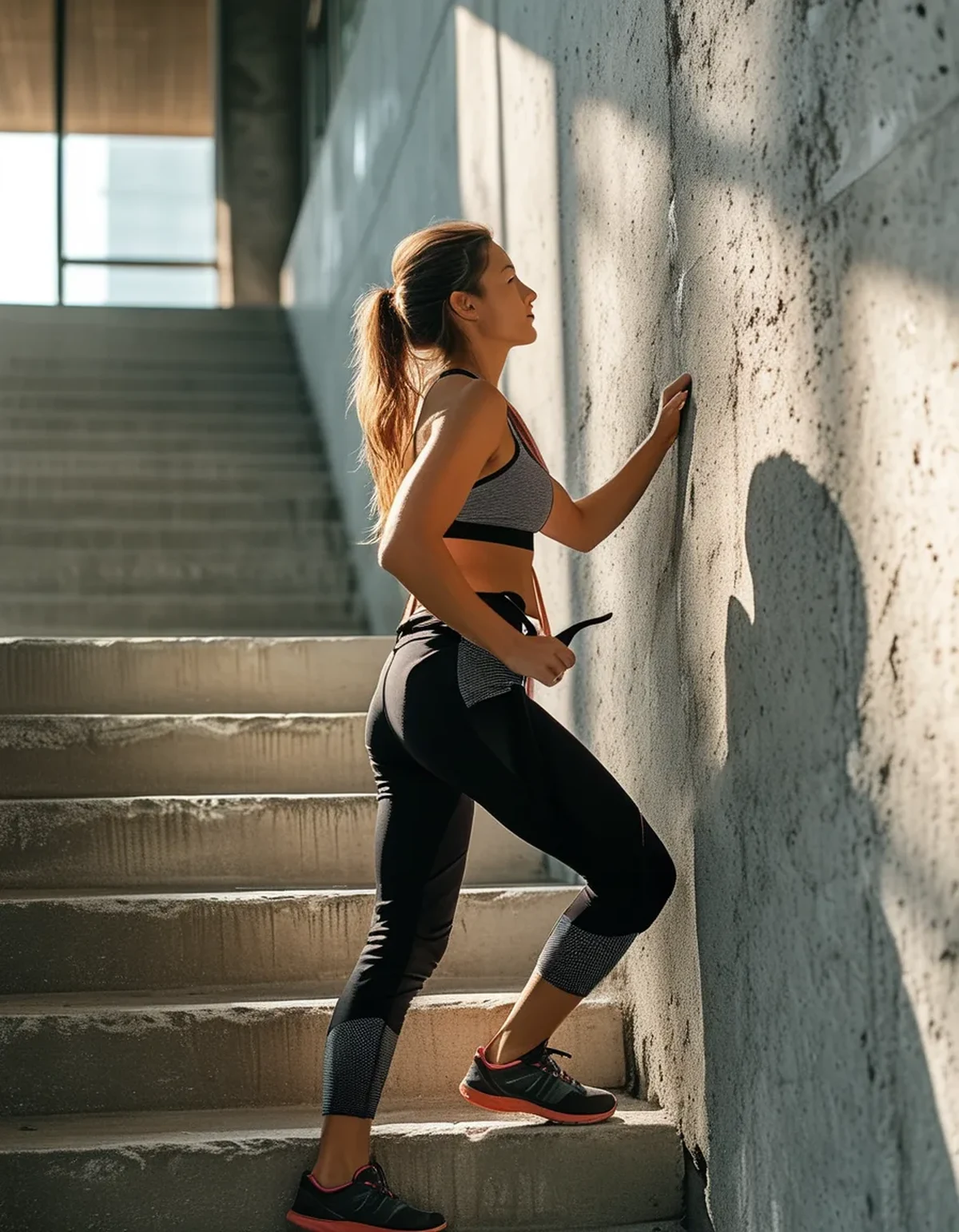
1. Stand on a step and check your heel. If it hangs off, you are on shallow treads. Expect calves, and reduce your intended volume by around a third for the first session.
2. Climb one flight at conversational pace and note which muscles you feel. That single flight tells you more than any number.
3. Set pace by the stairwell, not by your usual. Shallower treads mean shorter steps and higher cadence naturally — do not fight it, but do not add to it either.
4. Decide the descent separately. Descending is where injuries happen and where soreness comes from. On unfamiliar stairs, take the lift down for the first session and reintroduce descents once you know the dimensions.
5. Adjust volume, not intensity, for the first two sessions. Same effort, fewer flights, while your calves and achilles find out what they are dealing with.
A seasonal note: this matters most right now. Outdoor stair sessions — deep treads, low rise, glute-dominant — start moving indoors as the weather turns, and the indoor stairwell is usually shallower and steeper. That transition is the single most common cause of autumn achilles complaints in stair-trained people. Halve the first indoor session.
Can you use tread depth deliberately?
Yes, and it is one of the more useful ways to vary stair training without changing anything else.
To emphasise glutes and quads: find the deepest treads you can — outdoor stadium steps, wide municipal staircases, older public buildings. Take them two at a time with a full foot landing and a deliberate push through the heel.
To emphasise calves and achilles endurance: shallow indoor stairwells, one step at a time, forefoot landing, consistent cadence. Treat it as calf training and program it accordingly — meaning not the day before or after heavy calf or plyometric work.
To build general capacity: alternate between them across the week rather than doing the same stairwell every session. Most people who plateau on stair workouts have been doing the identical stimulus for months, and switching buildings changes more than adding flights would.
One progression to be careful with. Adding a weighted vest on shallow treads increases calf load disproportionately, because the position is already the limiting factor. If you are using a vest, use it on deep treads.
Persistent achilles or knee pain from stair training is worth having assessed rather than programming around. This is general information, not medical advice.
FAQ: Stair Dimensions, Answered
How do I measure tread depth without a tape measure?
Use your own foot. Stand normally on a step and look at your heel. Fully on with room to spare is deep; heel overhanging is shallow. It is not precise, but it is the measurement that actually matters for your body.
Why do some stairwells feel steeper than others at the same rise?
Usually because the tread is shallower. A shorter tread with the same rise produces a steeper pitch angle, and your body reads the pitch rather than the individual dimensions.
Should I avoid shallow-tread stairwells entirely?
No — they are a legitimate and useful stimulus, and they are what most people have access to. Just program them as calf-dominant work rather than treating them as interchangeable with outdoor steps.
TL;DR:
- Tread depth decides which muscles work: deep treads load glutes and quads, shallow treads load calves and achilles.
- Rise varies less and matters most on the descent, where a high rise means more eccentric quad load.
- Check by standing on a step: heel hanging off means shallow, so cut volume by a third on the first visit.
- Moving from outdoor steps to an indoor stairwell in autumn is the classic setup for achilles trouble — halve the first session.
- Use it deliberately: deep treads two at a time for glutes, shallow treads at steady cadence for calf endurance.
Next time a familiar-looking stairwell wrecks you, stand on one step and look at your heel before you decide you had an off day. It is a ten-second check that explains most of the sessions that did not go the way the numbers said they should.
Keep Reading
This article is for general informational and styling purposes only. Fit, sizing, and product availability may vary.